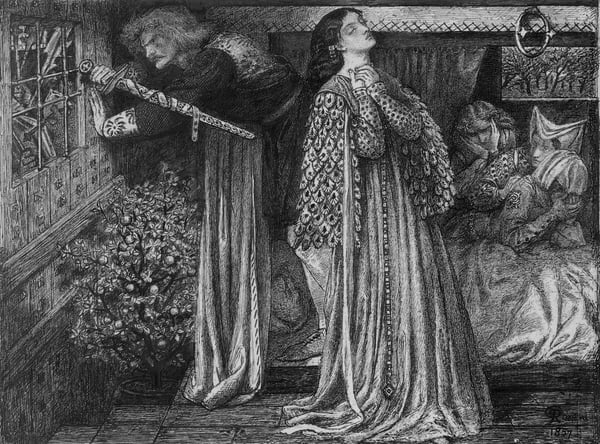
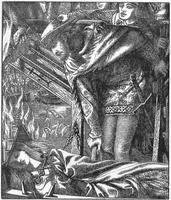
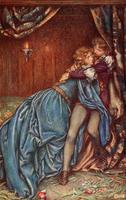
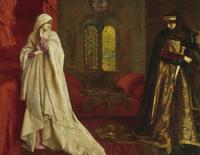
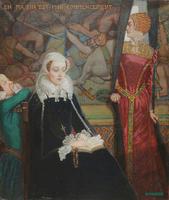
As a work of Romanticism and a literary painting, Dante Gabriel Rossetti’s Sir Launcelot in the Queen’s Chamber derives its significance from its embodiment of key Romantic ideals—particularly the deep engagement with medieval chivalric romance and the fusion of visual art with narrative literature. The painting draws on Arthurian legend, a favorite source for Romantic artists seeking to evoke an idealized, emotionally charged past. Rossetti’s treatment is notable for its concentration on a single, fraught moment from the story: Sir Launcelot’s clandestine presence in Queen Guinevere’s private chamber, a scene laden with tension, illicit love, and moral ambiguity.
Within the Romantic period, this work stands out for its intense focus on psychological atmosphere and symbolic detail. Rossetti prioritizes the emotional resonance of the literary moment over strict historical accuracy, using composition, color, and gesture to convey the characters’ inner turmoil. The painting’s significance also lies in its role as a precursor to the Pre-Raphaelite Brotherhood’s later principles—rejecting academic conventions in favor of vivid, symbolic realism derived directly from textual sources. By rendering a literary scene with such palpable sensuality and dramatic intimacy, Rossetti affirms Romanticism’s core belief that art should stir the soul and transport the viewer into a realm of passion, nostalgia, and timeless storytelling.