Expertenanalyse zu Dante Gabriel Rossettis Tristram and Isolde Drinking the Love Potion
Stil: Romanticism · Genre: literary painting
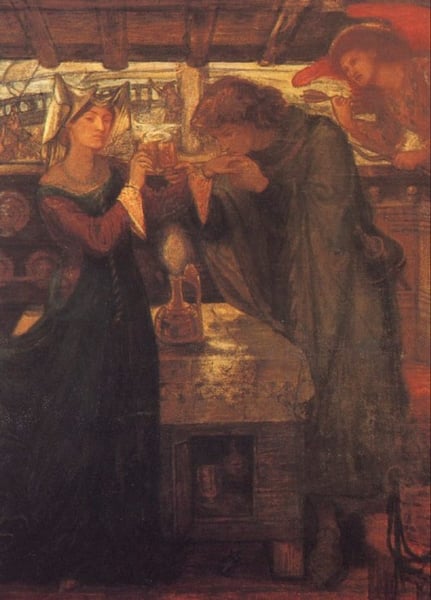
This painting, Tristram and Isolde Drinking the Love Potion (circa 1855–1860), is a quintessential example of Dante Gabriel Rossetti’s contribution to Romanticism through the lens of the Pre-Raphaelite Brotherhood—a movement that rejected industrial materialism in favor of medieval romance, intense emotion, and symbolic storytelling.
What makes it significant within Romanticism and its genre:
-
Medieval Revival & Literary Subject: The work is a literary painting drawn from Arthurian legend, specifically the tragic romance of Tristan and Iseult. Rossetti, like many Romantics, turned to medieval sources as a purer, more spiritual alternative to modern life. The moment captured—the fateful drinking of the love potion—is the pivot on which the entire doomed love story turns, embodying Romantic fatalism and the concept of love as an irresistible, transcendent force that defies social order.
-
Pre-Raphaelite Symbolism & Detail: Rossetti’s close attention to symbolic objects (the cup, the potion, the lovers’ clasped hands) and his vibrant, jewel-toned palette are hallmarks of Pre-Raphaelitism. The intense reds and deep greens heighten the emotional stakes. The figures are frozen in a charged, almost ritualistic gesture, emphasizing the moment’s spiritual and erotic significance—a Romantic idealization of passion over reason.
-
Emotional Intensity and Beauty: Unlike earlier Romantic history painting, Rossetti’s focus is on psychological interiority. Tristram and Isolde do not gaze at the viewer; they are locked in a mutual trance, their faces reflecting a mix of awe, desire, and foreboding. This reflects the Romantic obsession with sublime emotion—love as both ecstasy and doom.
-
Influence on Later Symbolism and Aestheticism: This painting bridges Romanticism’s emotional excess with the later Symbolist movement. Rossetti’s haunting, almost androgynous beauty and his use of flat, decorative patterns (like the tapestry-like background) anticipate the 1890s Aesthetic movement, making this work a key precursor to fin-de-siècle visual culture.
In sum, Tristram and Isolde Drinking the Love Potion is significant because it crystallizes the Pre-Raphaelite Romantic vision: a lush, sensory fusion of literature, medievalism, and intense inner feeling, challenging both academic classicism and industrial modernity.
Museum / Gallery
Visuell ähnlich
20 Werke mit ähnlicher Komposition und Farbpalette
Christ and the Samaritan at the Well
Rembrandt
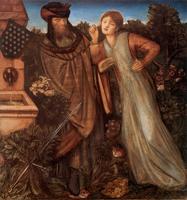
King Mark and La Belle Iseult
Edward Burne-Jones
Fair Rosamond and Queen Eleonor
Edward Burne-Jones
The celebration of the wedding agreement
Mikhail Shibanov
Tavern Scene
Jan Steen
The First Madness of Ophelia
Dante Gabriel Rossetti
Inn with drunken peasants
Adriaen Brouwer
A Soldier, An Old Woman and a Young Woman
Pieter Codde
Self-Portrait with Saskia in the Parable of the Prodigal Son
Rembrandt
Scena Dell'ostello
Pieter Brueghel the Younger
The Emmaus Miracle
Adam Elsheimer
Cinderella
Edward Burne-Jones
Study from Tintoretto's Adoration of the Magi
John Ruskin
Esther's Banquet
Salomon Koninck
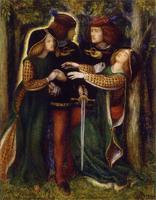
How They Met Themselves
Dante Gabriel Rossetti
The Stall Keeper
Adriaen van Ostade
Meal
Jan Steen
Christ with Mary and Martha
Tintoretto
Banquet Scene
Jacopo Bassano
The King Drinks
Jacob Jordaens