Expert Analysis: Archangel Gabriel by Andrei Rublev
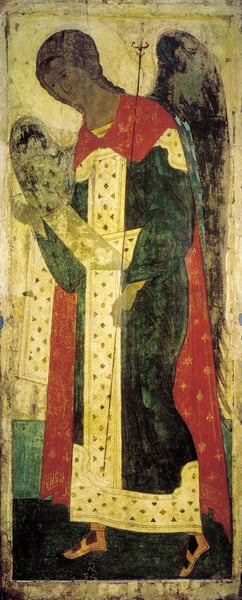
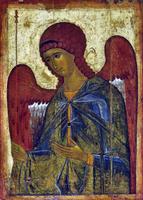
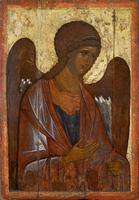
Andrei Rublev’s Archangel Gabriel is a transcendent example of the Moscow school of icon painting, a work that refines the rigid spiritual formalism of Byzantine tradition into a warmer, more humanly accessible vision of the divine. Painted for the iconostasis of the Cathedral of the Annunciation (or possibly part of a Deesis tier), this icon represents Gabriel not merely as a herald but as a serene, contemplative intermediary between heaven and earth.
Stylistic and Technical Significance
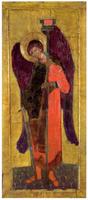
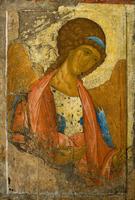
Rublev’s Gabriel breaks from the austere, elongated proportions typical of earlier Byzantine icons. The archangel’s figure is more softly modeled, with a gentle inclination of the head and a downward gaze that invites the viewer into a moment of silent communion. The drapery falls in fluid, lyrical lines—a hallmark of Rublev’s hand—whose rhythmic folds suggest both celestial lightness and the dignified stillness of a sacred being. The palette is dominated by cool blues and greens, the “Rublev blue” (a luminous lapis-based pigment) that seems to hold its own light, contrasted with warm ochre and gold highlights. This color harmony creates an otherworldly radiance, reinforcing the icon’s role as a window to the heavenly realm.
Iconographic and Symbolic Depth
Gabriel is shown with wings, nimbus, and a labarum (staff or scroll) signifying his role as messenger. The icon’s composition focuses entirely on the archangel’s presence, stripping away extraneous narrative detail. Rublev conveys Gabriel’s humility and power through subtle asymmetry: the slight tilt of the axis of the wings, the delicate positioning of the hands, and the quiet intensity of the eyes. The gold ground is not a mere backdrop but an active field of divine energy, pressing the figure forward into the viewer’s space.
Historical and Spiritual Context
Rublev worked during a period of recovery after the Mongol invasions, when Russian Orthodox spirituality was seeking a more intimate, mystical expression. In this icon, he synthesizes the theological rigor of Byzantine icons with a distinctly Russian tenderness—a sense of compassionate stillness. The Archangel Gabriel is significant because it exemplifies the Moscow school’s achievement: making the abstract, otherworldly figures of Orthodoxy feel palpably present without losing their sacred transcendence. It stands as a masterwork of iconography, where medium, color, and line are the vocabulary of prayer.