Análisis experto de Mikula Selianinovich de Mikhail Vrubel
Estilo: Art Nouveau (Modern) · Género: literary painting
Expert Analysis of Mikhail Vrubel’s Mikula Selianinovich (Art Nouveau / Modern)
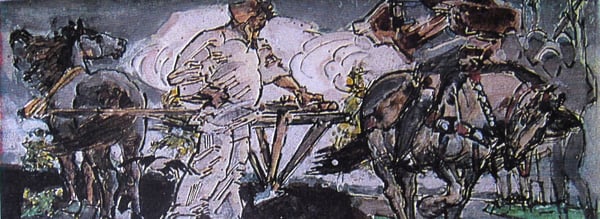
Mikhail Vrubel’s Mikula Selianinovich exemplifies the artist’s singular ability to fuse Russian national mythology with the decorative, organic language of Art Nouveau. The painting derives from the traditional bylina (oral epic) of Mikula Selianinovich, a peasant bogatyr whose superhuman strength comes from his connection to the land—a distinctly Slavic inversion of the aristocratic knight.
Significance within Art Nouveau:
Vrubel’s treatment is quintessential Art Nouveau in its use of sinuous, flowing line and mosaic-like color patches. The figure of Mikula is rendered with a rhythmic, almost calligraphic contour that merges into the surrounding soil and vegetation, embodying the movement’s obsession with the “line of beauty” and the unity of form and decoration. The earthy palette—ochres, deep greens, and glimmering blues—suggests both the mineral richness of the earth and the ethereal, jewel-toned luminosity Vrubel admired in Byzantine mosaics and medieval stained glass.
Significance within Vrubel’s Oeuvre and Period:
- Literary painting as national revival: By drawing on a folk epic, Vrubel aligns with the late-19th-century Russian revival of native lore (e.g., by composers like Rimsky-Korsakov). Rather than a purely historical illustration, he presents Mikula as a symbol of the mystical, indomitable Russian soil—a modern, Symbolist reinterpretation.
- Mannerist abstraction: Vrubel flattens perspective and distorts anatomy (note the exaggerated hands and the swirling forms of the plow), anticipating the expressive distortions of later Modernism. The canvas’s surface is treated as a decorative field where the hero’s body and the earth become one organic pattern.
- Craftsmanship and medium: Vrubel’s technique—thick impasto, fractured brushstrokes, and shimmering highlights—creates a tactile, almost encrusted surface that feels both ancient and avant-garde, bridging folk art and the “total work of art” ideal of Art Nouveau.
In summary, Mikula Selianinovich is a landmark of Russian Art Nouveau: a literary painting that transforms national epic into a visionary, anti-naturalistic design. Its significance lies in its seamless marriage of folk identity with the international modernist vocabulary of fluid line, symbolic color, and decorative surface—making Vrubel a pivotal figure in the transition from 19th-century realism to 20th-century abstraction.
Museum / Gallery
Visualmente similares
20 obras con composición y paleta relacionadas
Hungarian farmer's wagon by the water
August von Pettenkofen
Scene
John Augustus Atkinson
Carrying Horse
Ilya Repin
On the Tow-path, a Halt
Theodore Robinson
Novgorod. Returning from the fair.
Pyotr Konchalovsky
The collector of gravel and sand from the rivers
Amedeo Bocchi
Zigeunerfamilie Am Planwagen
Otto Mueller
Mule
Pablo Picasso
Asiago (Vicenza)
Ettore Tito
White Wall
Kmetty János
Fishermen with a Horsedrawn Sledge on the Beach near Scheveningen
Hendrick Avercamp
Daylabourers with Wheelbarrows
Vilmos Aba-Novak
The hawser
Ettore Tito
Ploughman and Three Women
Vincent van Gogh
Peasant Woman in a Cart
Valentin Serov
Reed harvest
Richard Friese
The man with the cart
Ivan Grohar
Plowman
Kazimir Malevich
Plowman with Two Women
Vincent van Gogh
Untitled (Loading the Cart)
Frances Hodgkins