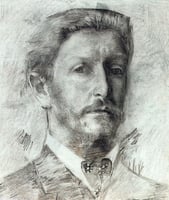
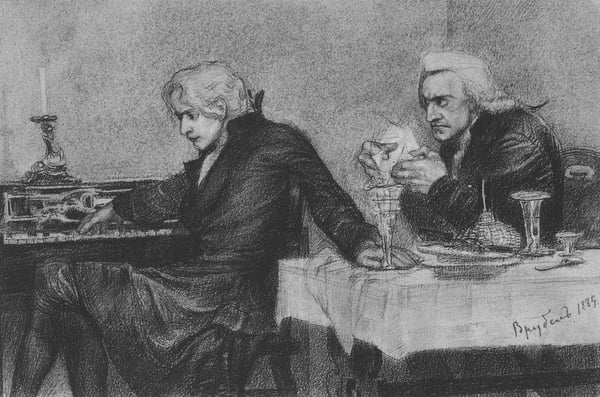
Salieri pours poison into a Mozart's glass
Details
Expert analysis of Mikhail Vrubel’s Salieri pours poison into a Mozart's glass
Style: Realism · Genre: literary painting
Based solely on the provided structured facts, the significance of Mikhail Vrubel’s "Salieri pours poison into a Mozart's glass" lies in its intersection of Realism and the literary painting genre.
As a work of Realism, it demonstrates the style’s commitment to depicting a scene with lifelike accuracy and psychological depth. Vrubel uses realistic techniques—precise anatomy, lighting, and spatial composition—to ground the dramatic, historical moment in tangible, believable human behavior. This makes the act of poisoning feel immediate and visceral, rather than allegorical.
Simultaneously, as a literary painting, the work draws its narrative from Alexander Pushkin’s play Mozart and Salieri (part of his "Little Tragedies"). By choosing this specific literary source, Vrubel engages with a key cultural debate of the 19th century: the nature of artistic genius, jealousy, and morality. The painting becomes a visual commentary on the text, bringing Pushkin’s psychological conflict into a concrete, realistic form.
The significance, therefore, is twofold: it showcases how Realism can be harnessed not just for everyday life but for high literary drama, and it elevates a literary scene into a tangible, emotionally resonant image that captures the moral tension of the original story. This combination anchors the work as a sophisticated example of narrative painting within the Realist tradition.
Visually similar
20 works with related composition and palette
A Morning with Liszt (Hungarian Composer)
Josef Kriehuber
Jan Ladislav Dussek (1760–1812)
Henri-Pierre Danloux
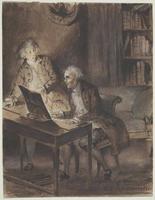
Willibald von Glueck at the Clavecin Composing the Score of his Armide
Eugene Delacroix
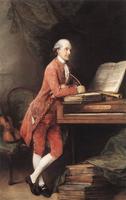
Johann Christian Fischer
Thomas Gainsborough
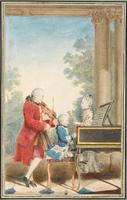
Leopold Mozart with Wolfgang Amadeus and Maria Anna
Louis Carrogis dit Carmontelle
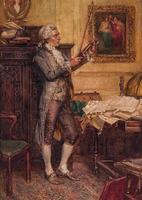
Gentleman
Arthur David McCormick
The Forestier Family
Jean Auguste Dominique Ingres
Portrait of the French Composer Pierre Zimmermann
Antoine-Jean Gros
Lomonosov in Germany. The scientific Debate.
Eugene Lanceray
A difficult audition
Johann Hamza
Duke of Alba
Francisco Goya
Celebrating childbirth, from act IV of Ludvig Holberg's play Barselstuen
Wilhelm Marstrand
The Connoisseurs. John Caw, John Bonar and James Bruce
David Allan
Chess Game
Johann Erdmann Hummel
The Marriage Contract
William Hogarth
Composer
Francis Day
Domènec Terradellas
Pier Leone Ghezzi
Evensong
Edward Robert Hughes
Um compasso difícil (Lição de violino)
Jose Malhoa
Scene
Walter Sadler