Cloudy day
Ivan Shishkin sanatçısının Cloudy day eseri hakkında uzman analizi
Tarz: Realism · Tür: landscape
Expert Analysis of “Cloudy Day” by Ivan Shishkin
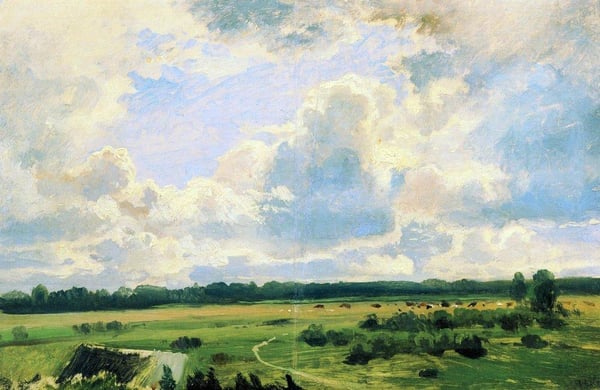
Ivan Shishkin’s “Cloudy Day” stands as a quintessential example of Realist landscape painting, capturing the profound beauty of the natural world with unflinching fidelity. Executed within the tenets of 19th‑century Russian Realism, the work moves beyond mere topographic record to become a meditation on atmosphere, light, and the transient moods of nature.
Significance within Realism and Shishkin’s Oeuvre:
True to the Realist creed, Shishkin rejects idealization or romantic exaggeration. Instead, he presents a seemingly ordinary, overcast scene with painstaking precision. The title itself—“Cloudy Day”—signals a shift away from the dramatic sunsets or sublime storms favored by earlier Romantic painters. Here, the significance lies in Shishkin’s ability to extract monumental dignity from a subdued, everyday weather event. The diffused, gray light mutes colors, forcing the viewer to attend to subtle tonal gradations in the sky, the texture of foliage, and the damp weight of the atmosphere. This attention to atmospheric perspective and optical truth is a hallmark of Shishkin’s mature style and of Russian Realism’s broader mission to render nature without artifice.
Key Technical and Expressive Achievements:
- Cloud Study: Shishkin’s handling of the overcast sky is masterful—layered, cool whites and grays create a sense of deepening moisture, threatening rain yet maintaining a luminous, even glow. This challenges the artist to model form without strong shadows, relying on subtle shifts in value.
- Earth and Vegetation: The lower portion of the composition—likely a forest edge or expansive field—is rendered with the microscopic detail typical of Shishkin. Each blade of grass, each mossy branch is distinct, yet they cohere into a unified, tactile whole. The cloudy light softens edges, unifying the landscape in a single, hushed key.
- Mood and National Identity: For the Russian public, such scenes evoked the familiar, melancholic beauty of the northern plains. The cloudy day becomes a metaphor for reflective solitude, a quiet patriotism that celebrates Russia’s unassuming landscapes over grand Alpine vistas.
Conclusion:
“Cloudy Day” is significant because it transforms a modest meteorological condition into a vehicle for virtuoso realism. Shishkin demonstrates that the highest artistry lies not in inventing dramatic sights, but in seeing the ordinary with extraordinary clarity. In this work, the clouds are not a backdrop but the protagonist—a testament to Realism’s power to invest every aspect of the natural world with weight, truth, and quiet emotional resonance.
Görsel olarak benzer
İlişkili kompozisyon ve renk paletine sahip 20 eser
Dune
Johan Hendrik Weissenbruch
The Vladimir's road
Isaac Levitan
Field
Isaac Levitan
Road
Isaac Levitan
Study for The Meadows
Thomas Eakins
Landscape with Dunes
Vincent van Gogh
The Grape Harvest at Sevres
Camille Corot
Dark Trees, Cincinnati
John Henry Twachtman
A Back Road
Childe Hassam
Sussex Downs
James Charles
Berneval Meadows, Morning
Camille Pissarro
Landscape in the Ile de France
Paul Cezanne
View Of Méréville
Maximilien Luce
A LINCOLNSHIRE LANDSCAPE
Edward Arthur Walton
Flying Shadows
Willard Metcalf
Stour River
Frederick George Cotman
The Passing Storm
Granville Redmond
Landscape
John Henry Twachtman
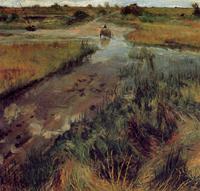
Swollen Stream at Shinnecock
William Merritt Chase
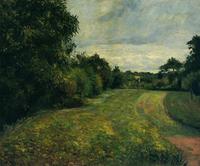
The backwoods of St. Antony, Pontoise
Camille Pissarro