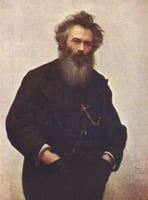
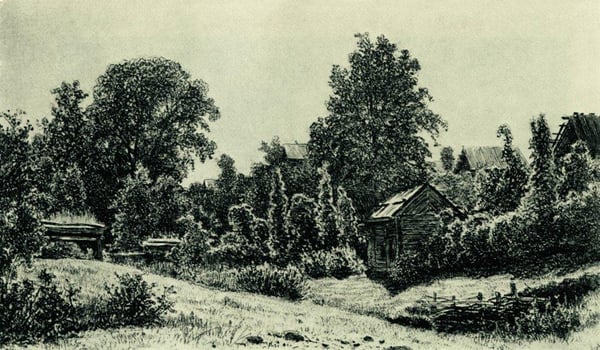
Expertenanalyse zu Ivan Shishkins Landscape
Stil: Realism · Genre: landscape
Ivan Shishkin, "Landscape" (c. 1880s–90s) – Expert Analysis
Style: Realism
Genre: Landscape
Ivan Shishkin stands as the unrivaled master of Russian Realist landscape painting, often hailed as the “tsar of the forest.” In this unnamed but quintessential work, titled simply "Landscape," he demonstrates the core principles that make his oeuvre significant within both the Realist movement and the broader history of art.
What makes it significant:
-
Scientific precision fused with poetic grandeur – Shishkin was trained at the Moscow School of Painting, Sculpture and Architecture and later at the Imperial Academy of Arts, but his true education came from direct observation of nature. He would spend hours in the forest, studying every root, needle, and ray of light. In "Landscape," this results in an almost botanical accuracy—each pine tree is rendered with individual bark texture, needle clusters, and shadow patterns—yet the composition never feels dry or documentary. Instead, the detail serves a larger emotional purpose: to convey the sublime stillness and resilience of the Russian wilderness.
-
Monumentalizing the ordinary – Unlike Romantic landscapes that dramatize storms or exotic vistas, Shishkin finds epic scale in a simple forest clearing or a cluster of ancient pines. The composition typically shows a modest foreground of ferns, moss, and fallen logs, leading the eye into a dense, towering woodland that seems to stretch infinitely. This approach elevates humble, everyday nature to the level of national iconography, making it a vehicle for Russian identity during a period of growing cultural self-awareness.
-
Mastery of light and atmosphere – Shishkin’s Realism is not a flat, photographic copy; it is a dynamic study of how sunlight filters through foliage, how shadows pool under a canopy, and how the air itself feels humid and cool. In "Landscape," the interplay of bright, dappled light against deep, resinous shadows creates a tactile sense of place. The viewer can almost smell the pine needles and hear the slight rustle of wind. This atmospheric sensitivity aligns him with the Barbizon school of France—artists like Théodore Rousseau and Charles-François Daubigny—but Shishkin’s vision is distinctly Russian in its solemnity and scale.
-
A bridge between Realism and the later Russian landscape tradition – Shishkin was a founding member of the Peredvizhniki (The Wanderers), a group of realist painters who rebelled against academic conventions to depict the real lives and landscapes of Russia. His forests became a symbol of national endurance and natural beauty, influencing later generations, including Isaac Levitan and the symbolist landscapes of the Silver Age. "Landscape" thus stands as a transitional work: utterly faithful to observable reality, yet pregnant with the spiritual weight that would define later Russian nature painting.
In summary, this painting is significant because it embodies the highest ideals of Realism—truth to nature, technical mastery, and emotional resonance—while simultaneously capturing the soul of the Russian landscape. Shishkin’s "Landscape" is not merely a view; it is an invitation to contemplate the quiet, enduring majesty of the natural world.
Visuell ähnlich
20 Werke mit ähnlicher Komposition und Farbpalette
Edge of the Forest
Ivan Shishkin
Sheds and gardens
Andrey Shishkin
Abandoned Mill 1
Fyodor Vasilyev
Village
Ivan Shishkin
At the edge of an oak forest
Ivan Shishkin
Bridge over a Brook
Fyodor Vasilyev
Edge of the Forest
Ivan Shishkin
Bridge
Ivan Shishkin
Forest River
Ivan Shishkin
Landscape with the Village Children
Efim Volkov
A yard
Vasily Polenov
A Peasant Carrying Milk Pales
Rembrandt
Motiv från Ryd
Gustaf Rydberg
Village
Fyodor Vasilyev
The Barn
Fyodor Vasilyev
Stream
Ivan Shishkin
Landscape. Pargolovo
Fyodor Vasilyev
Isbas lighted by sun
Isaac Levitan
Road
Isaac Levitan
Evening
Fyodor Vasilyev