Expert analysis of Diego Velazquez’s The Surrender of Breda
Style: Baroque · Genre: battle painting
Analysis of "The Surrender of Breda" by Diego Velázquez
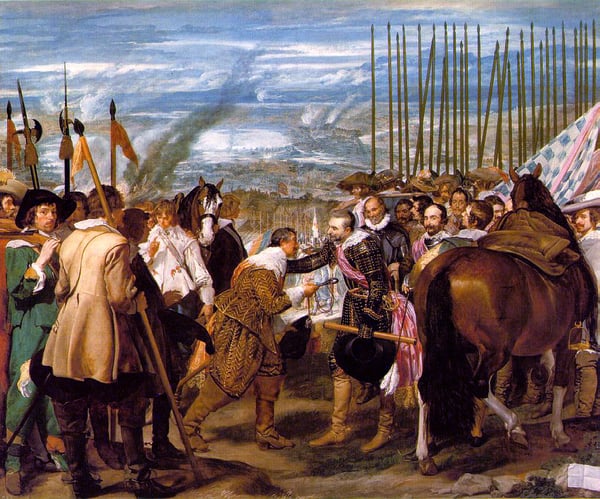
As an expert in Baroque art history, I can confirm that Velázquez’s The Surrender of Breda (c. 1635) stands as a monumental achievement within both the Baroque style and the genre of battle painting. It is significant precisely because it reimagines the military subject with a psychological and humanistic depth that was radical for its time, elevating a victory scene into a meditation on dignity, empathy, and the ritual of peace.
1. Humanization of the Battle Genre Unlike typical Baroque battle scenes that emphasize chaos, carnage, or triumphant generals, Velázquez focuses on the quiet moment of surrender. The defeated Dutch governor, Justin of Nassau, bows to offer the keys of Breda, while the Spanish commander, Ambrogio Spinola, dismounts and gently places a hand on his shoulder, preventing him from kneeling. This gesture—restraint and respect—transforms the composition into an act of mutual honor. Velázquez deliberately avoids glorifying violence; instead, he presents both parties with individual dignity, a strikingly modern, empathetic approach.
2. Baroque Realism and Compositional Innovation True to Baroque principles, Velázquez uses dramatic chiaroscuro and a sweeping sense of space. The foreground is a tightly focused, intimate group of figures, while the background opens to a vast, smoky landscape of the burning city and distant troops. This layered depth draws the viewer into the scene. The diagonal thrust of the lances and pikes creates a visual funnel leading the eye to the central handshake—a compositional device that stresses the moment of concord rather than conflict. The meticulous rendering of armor, velvet, and faces demonstrates Velázquez’s mastery of texture and light, making the historical event feel immediate and tangible.
3. Sophisticated Political Nuance Painted for the Hall of Realms in the Buen Retiro Palace, the work was meant to celebrate a Spanish victory during the Eighty Years’ War. However, Velázquez, ever the courtier and observer, provides a balanced view. The Spanish soldiers are sturdy and disciplined; the Dutch are weary but not humiliated. Spinola’s gesture of sympathy was historically noted, and Velázquez immortalizes it as the moral core of the painting. This refusal to caricature the enemy imbues the work with a timeless commentary on the shared humanity of victor and vanquished.
4. A Masterpiece of Psychological Portraiture Velázquez infuses the figures with individual character. Spinola’s calm, weary resignation and Justin’s humble, upright acceptance are conveyed through subtle facial expressions and body language. Even the horses, the page boy, and the soldiers in the background are rendered with specific attention to their emotional states. This focus on interiority—a hallmark of Velázquez’s genius—lifts the painting from a mere record of a siege to a profound study of honor, mercy, and the cost of war.
Conclusion The Surrender of Breda is significant because it breaks the formula of the battle painting. Velázquez chooses the aftermath over the clash, sympathy over triumph, and stillness over fury. It remains a quintessential Baroque work in its theatricality, naturalism, and emotional complexity—and a humanist document that speaks across centuries.
Museum / Gallery
Visually similar
20 works with related composition and palette
Fundacion De Santiago
Pedro Lira
Battle
Adriaen van de Velde
Militia Company of District VIII under the Command of Captain Roelof Bicker
Bartholomeus van der Helst
Exaltação da Santa Cruz
Cristovao de Figueiredo
Mucius Scaevola
Hans Baldung
Los 13 de la Isla del Gallo
Juan Lepiani
Hudibras' First Adventure, from 'Hudibras' by Samuel Butler
William Hogarth
Officers And Sergeants Of The St. Hadrian Civic Guard
Frans Hals
The company of Captain Reinier Reael and Lieutenant Cornelis Michielsz. Blaeuw, known as the ‘Meagre Company’
Frans Hals
The Meagre Company
Pieter Codde
Mary Stuart at Crookstone
Giovanni Fattori
Conversion of Saul
Pieter Brueghel the Younger
Tiroler Landsturm
Joseph Anton Koch
The Kappeler milk soup
Albrecht Anker
The Defence of Cadiz against the English
Francisco de Zurbaran
Saint Paul Conduit À Damas Après Sa Conversion
Pieter Brueghel the Younger
Sobieski at Vienna
Jan Matejko
Way to Calvary
Albrecht Durer
Entrance of Dauphin, the Future Charles V, into Paris in 1358
Jean Auguste Dominique Ingres
Musicians in battle
Eduardo Zamacois