Expert analysis of Andy Warhol’s Electric Chair
Style: Pop Art · Genre: interior
Expert Analysis: Electric Chair by Andy Warhol
Andy Warhol’s Electric Chair (1964) is a defining work of Pop Art that transforms a grim institutional interior into a stark meditation on mortality, media, and mass production. Executed in the style’s signature blend of commercial silk-screening and deadpan repetition, the painting depicts the execution chamber of Sing Sing prison—an empty room centered on the electric chair bathed in harsh, artificial light.
Significance within Pop Art and Its Period
-
Elevating the Mundane and the Morbid: Warhol’s signature move—appropriating banal or taboo imagery from popular culture—reaches its most unsettling extreme here. Unlike his Campbell’s soup cans or Marilyn Monroe portraits, Electric Chair presents a functional object of state-sanctioned death as an everyday interior. In Pop Art, the distinction between high and low culture dissolves, and Warhol forces viewers to confront capital punishment with the same impassive gaze they would give a supermarket product.
-
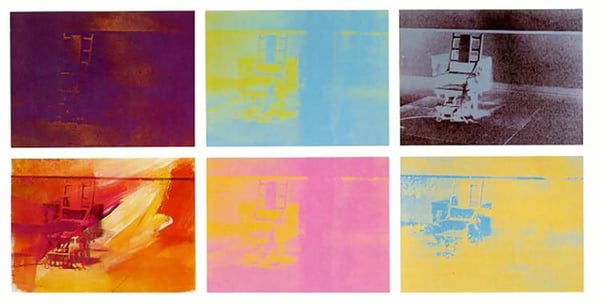
Repetition and Desensitization: The Electric Chair series exists in multiple versions—some monochrome, some overlaid with garish colors, others silkscreened in repeating grids. This repetition mirrors the assembly-line logic of both Pop Art production and the American justice system. By presenting the chair again and again, Warhol mimics the way media deadens emotional response through constant exposure to images of violence. The empty room becomes a symbol of institutional indifference.
-
Interior as Psychological Space: Categorized as “interior” genre, the painting subverts traditional expectations. There is no human figure; the chair itself is the subject, hauntingly vacant. This absence amplifies the tension, as the viewer becomes the only witness. The cold, hard light and stark shadows recall police crime-scene photography, reinforcing Pop Art’s debt to documentary and advertising aesthetics while creating an unnerving stillness.
-
Context of the Death Penalty in 1960s America: Produced during a period of national debate over capital punishment (the last U.S. executions before a brief moratorium occurred in the early 1960s), Electric Chair is both a historical document and a political statement. Warhol, however, remains characteristically ambiguous—he neither preaches nor judges. Instead, he presents the interior as an icon, stripped of narrative, leaving the cultural weight to rest entirely on the viewer.
In essence, Electric Chair is significant because it pushes Pop Art beyond commercial celebration into critical, uncomfortable territory. It takes an interior—the most private, functional of spaces—and forces it into the gallery as a mirror of American society’s capacity for routinized violence. The work’s power lies in its emotional flatness, its refusal to explain, and its insistence that even the most horrifying objects can become reproducible products in the age of mechanical reproduction.
Visually similar
20 works with related composition and palette
Big electric chair
Andy Warhol

Electric Chair
Andy Warhol
Early electric chair
Andy Warhol
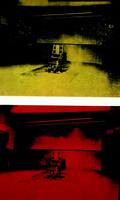
Electric Chair
Andy Warhol
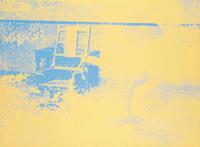
Electric Chair
Andy Warhol
Double silver disaster
Andy Warhol
Orange Disaster
Andy Warhol
Scarlet Ribbons, Lovely Ribbons
Jack Vettriano
Self-Portrait
Horia Damian
Untitled
Zdzislaw Beksinski
Glassless stereoscopic movie system
David Kakabadze
Composition sketch for Seated Old Woman
Paula Modersohn-Becker
Trône
Horia Damian
Self-Portrait Jumping
Brion Gysin
Matisse in His Studio
Brassai
Window Light
Charles Blackman

Catch Me In 10k
Surf Dont Fall
Room Situation
Vito Acconci
Vertical Progressive
Billy Apple
Saulains rīts.
Guntis Strupulis