Analisi esperta di Madonna And Self-Portrait With Skeleton's Arm (after Munch) di Andy Warhol
Stile: Pop Art · Genere: portrait
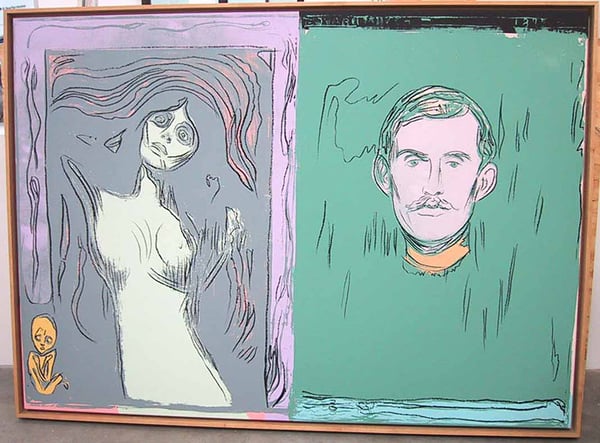
Andy Warhol’s Madonna And Self-Portrait With Skeleton’s Arm (after Munch) exemplifies a key Pop Art strategy: the recontextualization of iconic imagery from art history and popular culture. By appropriating Edvard Munch’s symbolist masterpieces—specifically Madonna (1894–95) and Self-Portrait with Skeleton Arm (1895)—Warhol collapses the boundary between high art and mass reproduction, a hallmark of his practice.
Significant to the Pop Art movement, this work transforms Munch’s emotionally charged, existential figures into a flat, serial image. Warhol employs his signature silkscreen technique, applying bold, unnatural colors (often garish pinks, blues, or yellows) and eliminating the original’s atmospheric shading. The result replaces Munch’s psychological depth with a superficial, graphic immediacy that mimics advertising and mechanical printing. This flattening effect underscores Pop Art’s critique of commodification: even the most anguished motifs of death and desire become reproducible consumer goods.
The subject matter further amplifies Warhol’s thematic preoccupations. Munch’s Madonna depicts a sensual, almost hieratic female figure, while his self-portrait features a skeletal arm—a memento mori. By combining them, Warhol creates a dialogue between Eros and Thanatos, beauty and decay. This directly echoes his own earlier series Death and Disaster (e.g., car crashes, electric chairs), where celebrity and catastrophe coexist. Here, Warhol himself appears in the guise of Munch, inserting his own image into the composition, simultaneously paying homage and asserting his status as an icon of Pop celebrity.
Ultimately, the artwork is significant for its meta-commentary on artistic influence and mortality. It shows Pop Art not merely as a celebration of consumer culture but as a lens to reexamine historical art through a contemporary, ironic filter. Warhol’s “after Munch” series (1984) reaffirms his ability to drain traditional symbols of their original aura while imbuing them with new meaning—a quintessential Pop maneuver that questions authenticity, authorship, and the passage of time.
Visivamente simili
20 opere con composizione e palette affini
Figure
Nikos Nikolaou
River Ways
David Michael Hinnebusch
Pinky
David Michael Hinnebusch
Femme
Serge Brignoni
Anna Margit, Női Portré
Anna Margit
Ritratto N° 25
Enrico Prampolini
Woman/Verso: Untitled
Willem de Kooning
Torse de femme avec mains
Le Corbusier
An Artist and His Model
Ding Yanyong
Girl
Vilen Barsky
Trois Têtes dans un Medaillon
Louis Soutter
Fränzi Reclining
Erich Heckel
Portrait 4
Aurel Cojan
Water Painting
Gary Hume
Three Studies for Portrait of Henrietta Moraes
Francis Bacon
Entreneuse
Tano Festa
La Femme Tondue
Anton Prinner
The Woman Who Was Jealous
Beatrice Wood
Untitled
Mikey William Cheung
Jack Kerouac
Larry Rivers