Analisi esperta di Marilyn Blue di Andy Warhol
Stile: Pop Art · Genere: portrait
Expert Analysis: "Marilyn Blue" by Andy Warhol
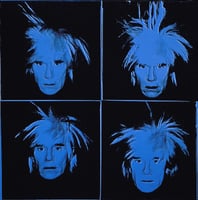
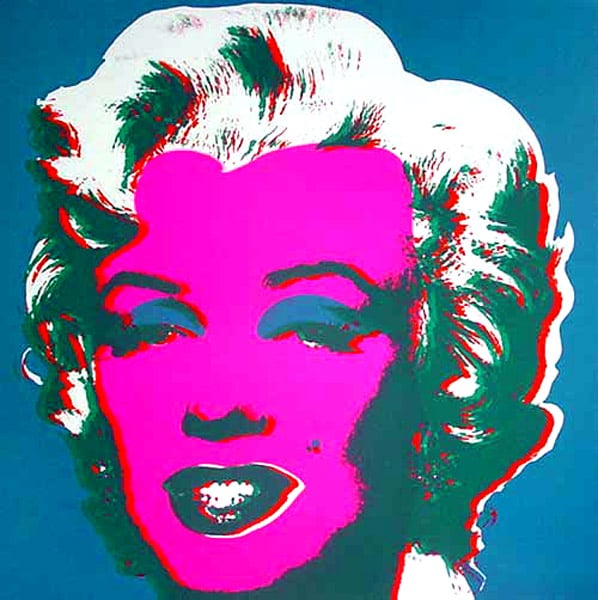
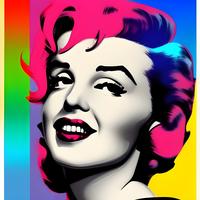
Andy Warhol’s Marilyn Blue stands as a quintessential example of Pop Art’s ability to transform mass-media imagery into high art while simultaneously interrogating celebrity culture, mortality, and mechanical reproduction. This portrait, part of Warhol’s iconic series based on a publicity still from the 1953 film Niagara, derives its power from a deliberate fusion of the personal and the impersonal.
Significance within Pop Art:
Warhol’s signature silkscreen technique here divorces the subject from its original context, reducing Marilyn Monroe to a flattened, high-contrast icon. The single, saturated blue hue—applied over a black-and-white photographic source—both estranges and elevates the sitter. Unlike the more famous multicolored Marilyn Diptych (1962), Marilyn Blue isolates a single, cool monochrome, emphasizing emotional distance and the artist’s fascination with the “blankness” of celebrity. The blue functions not as naturalistic skin tone but as a conceptual filter, suggesting melancholy, coldness, or the artificiality of Hollywood glamour.
Warhol’s repetition of this image across many works—Marilyn Blue being one of several single-color variants—is central to Pop Art’s critique of commodification. By presenting Monroe as a reproducible graphic, Warhol exposes the paradox of fame: the star is both universally recognized and utterly dehumanized. The work also gains poignancy from Monroe’s death in 1962, just years before this silkscreen was created (likely 1964). The blue palette can be read as a memorial, a screen through which we view a tragic icon turned into a product.
Formal and Technical Innovation:
The painting’s significance also lies in its method. Warhol’s use of photo-silkscreen allowed for slight variations in registration and paint application, creating subtle inconsistencies (e.g., blurred lips or shifted eyes) that humanize the mechanical process. In Marilyn Blue, the stark juxtaposition of flat background and carefully detailed features (the mole, the eyelashes, the red lips—often printed in a separate pass) demonstrates Warhol’s mastery of graphic precision within apparent carelessness. The work bridges Abstract Expressionist gesture (the uneven, hand-painted blue field) and Pop’s deadpan appropriation, marking a turning point where painting itself became a vehicle for mass-media critique.
In summary, Marilyn Blue is significant not only as a striking portrait of an American icon but as a key artifact of Pop Art’s central thesis: that in an age of mechanical reproduction, the image of a person can become more powerful—and more hollow—than the person themselves.
Visivamente simili
20 opere con composizione e palette affini
After Marilyn Pink
Andy Warhol
Marilyn Gray
Andy Warhol
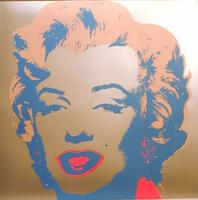
Marilyn Monroe
Andy Warhol
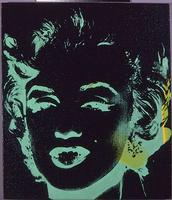
Marilyn Reversal
Andy Warhol
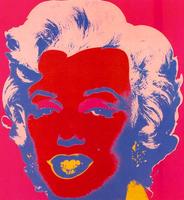
Marilyn Red
Andy Warhol
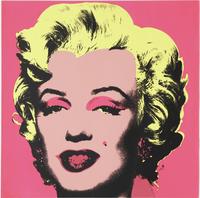
Marilyn Monroe
Andy Warhol
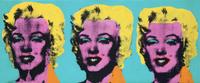
Three Marilyns
Andy Warhol
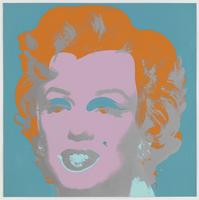
Untitled (from Marilyn Monroe)
Andy Warhol
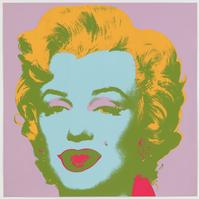
Untitled (From Marilyn Monroe)
Andy Warhol
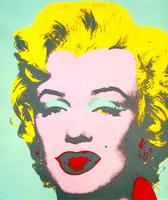
Marilyn
Andy Warhol
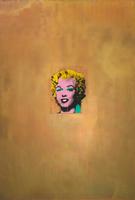
Gold Marilyn Monroe
Andy Warhol
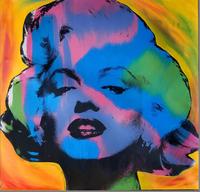
Marilyn Classic Multi Face Yellow
Steve Kaufman
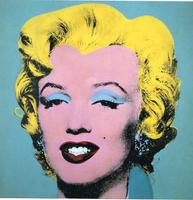
Marilyn
Andy Warhol
Marilyn Monroe Artwork in line art
Muntadher Saleh
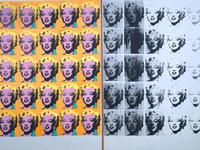
Marilyn Diptych
Andy Warhol
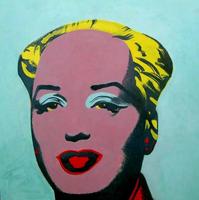
Untitled (Mao/Marilyn)
Yu Youhan
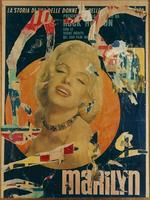
Marilyn
Mimmo Rotella
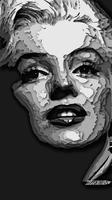
Marilyn Monroe layers
Muntadher Saleh
Monroe
ILYA CHERVONY
Marilyn
Robert Silvers