Analisi esperta di The Capricious Girl di Antoine Watteau
Stile: Rococo · Genere: pastorale
Expert Analysis of "The Capricious Girl" by Antoine Watteau
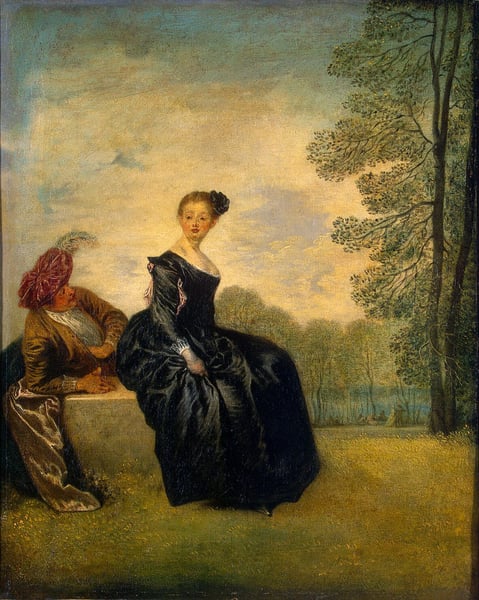
As a defining work of the Rococo period, "The Capricious Girl" exemplifies the style's celebration of fleeting pleasure, refined elegance, and theatrical charm. Painted by Antoine Watteau—a master of the fête galante—the artwork belongs to the pastorale genre, yet it transcends simple rural idealism by infusing it with a psychological complexity characteristic of Watteau’s finest works.
Significance within Rococo and the Pastorale Genre
The painting captures a quintessentially Rococo theme: the capriciousness of romantic desire. The title itself—The Capricious Girl—suggests a narrative of playful indecision or flirtatious whim, a subject that allowed Watteau to explore the transient moods of love and artifice. Unlike the earlier Baroque pastorale, which often portrayed idealized shepherds in a timeless Arcadia, Watteau’s version is tinged with a subtle melancholy and a sense of performance. The figures are not simple rustics but courtly participants in an elegant masquerade, reflecting the Rococo fascination with theater, masquerade balls, and the fleeting nature of pleasure.
Watteau’s unique contribution to the pastorale genre lies in his ability to merge natural landscape with staged human interaction. The composition likely places the “capricious” girl at the center of a delicate social dance—her gesture or expression implying a refusal or a tease, while her suitor responds with yearning or amusement. The soft, shimmering palette of pastel hues (typical of Rococo) and the dappled light filtering through foliage create an atmosphere of dreamlike intimacy. This atmospheric treatment elevates the scene beyond mere genre painting, making it a meditation on desire, hesitation, and the ephemeral beauty of the moment.
Why It Matters
“The Capricious Girl” is significant because it encapsulates Watteau’s revolutionary approach to the pastorale. Instead of depicting rustic labor or mythological allegory, he presents a psychological vignette—a snapshot of aristocratic dalliance where emotion is as important as scenery. This work helped define the Rococo’s shift toward private, sensual experiences, influencing later painters like Boucher and Fragonard. Moreover, the “capricious” element introduces a note of ambiguity: the viewer is left to interpret the girl’s intent, embodying the Rococo ideal of playful ambiguity rather than moral didacticism. In this way, Watteau’s painting stands as a bridge between the formal pastoral tradition and the more intimate, emotionally complex art of the later 18th century.
Museum / Gallery
Visivamente simili
20 opere con composizione e palette affini
An Embarrasing Proposal
Antoine Watteau
Sir George and Lady Strickland in the Park at Boynton Hall
Arthur Devis
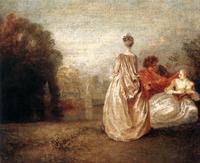
Two Cousins
Antoine Watteau
Portrait of Augusta of Saxe Gotha, Princess of Wales
Allan Ramsay
An Unknown Couple in a Landscape
Thomas Gainsborough
The Wiley Family
William Williams
Mary Amelia, 1st Marchioness of Salisbury
Joshua Reynolds
Portrait of a Standing Woman
Camille Corot
Mrs. Richard Brinsley Sheridan
Thomas Gainsborough
The Parasol
Francisco Goya
Portrait of Sarah Kirby (née Bull) and John Joshua Kirby
Thomas Gainsborough
The Honourable Frances Duncombe
Thomas Gainsborough
Mr. and Mrs. John Gravenor and their Daughters, Elizabeth and Ann
Thomas Gainsborough
The Souvenir
Jean-Honore Fragonard
Portrait of Mary Countess Howe
Thomas Gainsborough
Isabella, Viscountess Molyneux
Thomas Gainsborough
The Honorable Mrs. Graham
Thomas Gainsborough
Elizabeth Stuart, Queen of Bohemia
Gerard van Honthorst
Study For The Portrait Of Baroness Seillière
Ernest Hébert
Tircis and amaranth
Gustave Dore