Arrival of a New Governess in a Merchant House
Details
Expert analysis of Vasily Perov’s Arrival of a New Governess in a Merchant House
Style: Realism · Genre: genre painting
Expert Analysis: "Arrival of a New Governess in a Merchant House" by Vasily Perov
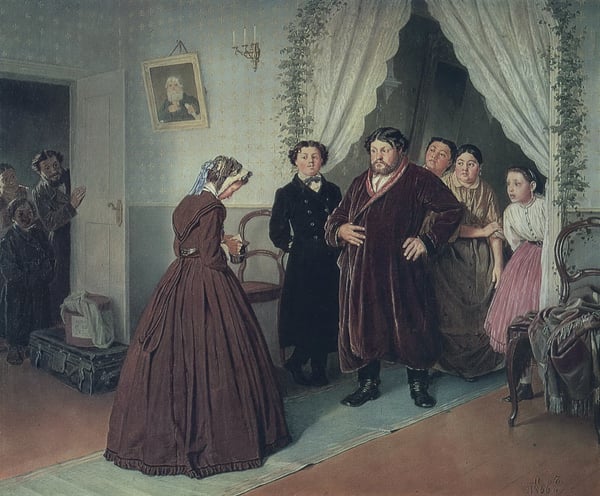
As a cornerstone of Russian Realism, Vasily Perov’s genre painting captures a moment of quiet social tension with unflinching honesty. The work depicts the arrival of a young, plainly dressed governess in the home of a prosperous merchant family. The scene is charged with psychological nuance: the governess stands hesitantly, her humble demeanor contrasting sharply with the smug, appraising stares of the merchant—a stout, self-satisfied figure—and his family, who examine her as though she were a purchased commodity.
Perov’s significance lies in his ability to transform a mundane domestic event into a biting social critique. The painting belongs to the critical realist tradition, a hallmark of the Russian Peredvizhniki (Wanderers) movement, which rejected idealized academic art in favor of exposing societal inequities. Here, Perov lays bare the class hierarchy and the precarious position of educated but impoverished women in 19th-century Russia. The merchant’s contemptuous posture and the governess’s anxious humility are rendered with a meticulous, almost photographic attention to detail—every figure’s expression, posture, and attire tells a story of power, deference, and quiet humiliation.
The composition reinforces this dynamic: the governess is isolated at the threshold, physically and symbolically caught between the street and the oppressive interior. The warm, rich colors of the merchant’s home (polished wood, heavy fabrics) create a suffocating opulence that emphasizes her alienation. Perov’s mastery of light and shadow further heightens the drama—a sliver of daylight from the open door illuminates the governess’s face, while the family remains in dim, judgmental shadow.
What makes this work especially significant is its microcosmic reflection of broader social change. Perov captures the moment when Russia’s rigid feudal structure was beginning to crack, and the rising merchant class wielded new economic power over the intelligentsia. By focusing on a quiet, everyday arrival, he elevates the ordinary into a powerful statement on class, gender, and the human cost of modernization—a defining achievement of Realist genre painting.
Visually similar
20 works with related composition and palette
The Doctor's waiting room
Vladimir Makovsky
The Sailor's Wedding
Richard Caton Woodville Sr.
Congratulation of betrothed in landlord's house
Grigoriy Myasoyedov
The first coat
Vladimir Makovsky
Poor Relations
George Goodwin Kilburne
The visit
Arturo Ricci
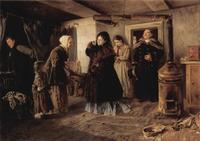
Visiting a poor people
Vladimir Makovsky
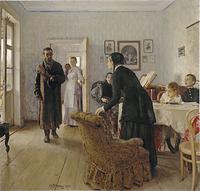
Unexpected Visitors
Ilya Repin
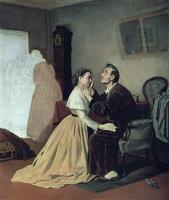
Arrival schoolgirl to a blind father
Vasily Perov
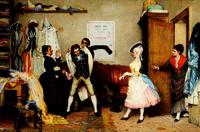
Dressing for the Masquerade
Eugene de Blaas
A Doctor and Some Women Attend to and Prepare Band
Albert Lynch
The Runaway Match
William Holbrook Beard
Literary reading
Vladimir Makovsky
The Major's Marriage Proposal
Pavel Fedotov
A family in an interior with a dog and cat
Adriaan de Lelie
This white-haired woman became Chimène again for one hour
Émile Bayard
The Evening Prayer
Peter Fendi
Christmas Time (also known as The Blodgett Family)
Eastman Johnson
The Venetian Lady's Morning
Pietro Longhi
Congratulations
Vladimir Makovsky