Analisi esperta di Grandfather and grandson di Vasily Perov
Stile: Realism · Genere: genre painting
Expert Analysis of Vasily Perov’s Grandfather and Grandson (Realism, Genre Painting)
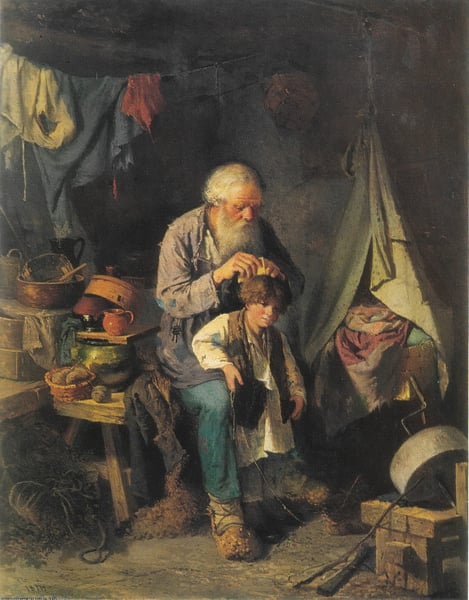
Vasily Perov, a leading figure in the Russian Realist movement of the 19th century, created Grandfather and Grandson as a poignant example of genre painting that transcends mere anecdote. The work’s significance lies in its unflinching yet compassionate portrayal of the human condition, a hallmark of the “Itinerant” (Peredvizhniki) school to which Perov belonged. These artists sought to depict the everyday lives of ordinary people—often the poor, the aged, and the marginalized—with a truthfulness that carried implicit social critique.
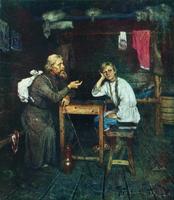
In this painting, Perov focuses on the intimate bond between generations, set against a stark, humble interior. The grandfather, weathered and stooped, embodies a lifetime of labor and hardship, while the young grandson, perhaps an orphan or abandoned child, clings to him. Their physical closeness—the grandfather’s protective hand or gaze—creates a powerful emotional resonance. Perov avoids sentimentality; instead, he uses muted earth tones, careful chiaroscuro, and a tightly cropped composition to draw the viewer into their confined world. The wrinkled faces, worn clothing, and absent luxuries speak to poverty, but the tenderness between the two offers a quiet dignity.
Stylistically, the painting exemplifies Realism’s rejection of idealization. Perov does not romanticize rural or working-class life; he shows its struggles as a direct commentary on post-reform Russian society (after the 1861 emancipation of the serfs). Yet the work is not merely documentary. The grandfather’s expression—weary but resolute—and the child’s vulnerability elevate the scene to a universal meditation on memory, legacy, and love.
Within the period, Grandfather and Grandson is significant because it encapsulates the Peredvizhniki mission: to make high art accessible and morally engaged. Perov’s empathy for his subjects challenged the imperial academy’s preference for history painting and mythology. Here, the “grand” themes of art—hope, sorrow, resilience—are found in two ordinary people. The painting thus becomes a testament to the power of realism to humanize social issues, influencing later Russian masters like Repin and even foreshadowing the psychological depth of 20th-century Expressionism.
Visivamente simili
20 opere con composizione e palette affini
De kraamkamer
Ferdinand de Braekeleer
Grandfather and grandchildren
Ludwig Knaus
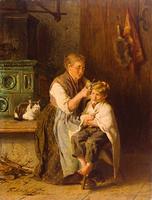
Mother cuts a boy's hair in the room with a tiled stove and a sleeping cat
Felix Schlesinger
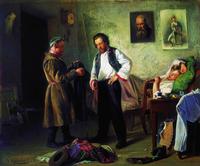
The artist, selling old stuff to Tatar (Artist's Studio)
Vladimir Makovsky
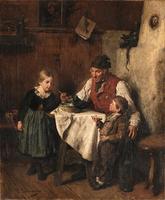
A feathered friend
Felix Schlesinger
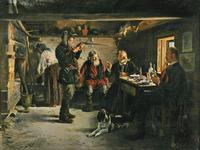
In the Forester's Hut
Vladimir Makovsky
Fire extinguished
Vincenzo Caprile
Three Peasants at an Inn
Adriaen van Ostade
Smokers in an Interior
David Teniers the Younger
Lean Kitchen
Jan Steen
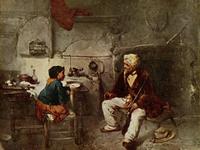
The hunter
Domenico Induno
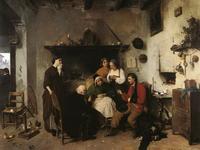
Tale of the wounded Garibaldian
Gerolamo Induno
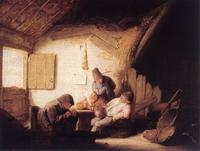
Village Tavern with Four Figures
Adriaen van Ostade
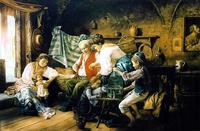
Family Games
Giovanni Battista Torriglia
The quack
Albrecht Anker
The Pancake Baker
Adriaen Brouwer
Solomonic wisdom
Ludwig Knaus
The barber
Nikolaos Gyzis
Future Monk
Nikolay Bogdanov-Belsky
Peasants in a tavern
Vladimir Makovsky