Expert analysis of Vasily Perov’s Hunting for wild boar
Style: Realism · Genre: genre painting
Analysis of "Hunting for wild boar" by Vasily Perov
Vasily Perov, a leading figure of the Russian Realist movement and a founding member of the Peredvizhniki (the Wanderers), created works that functioned as both vivid social documents and powerful critiques of 19th-century Russian life. Hunting for wild boar exemplifies the Realist commitment to depicting everyday scenes with unvarnished truth, but Perov’s treatment of this seemingly straightforward genre subject carries deeper significance.
The Significance within Realism
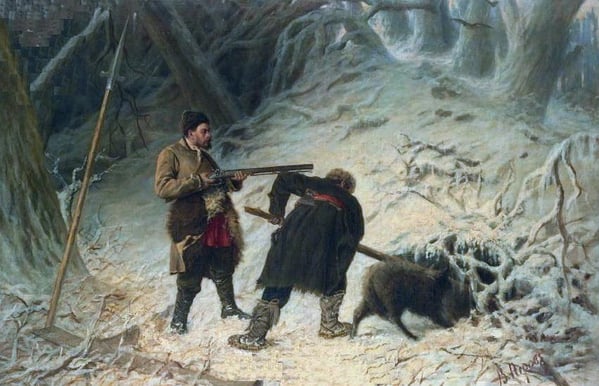
At first glance, the painting appears to be a conventional hunting scene, a popular genre across European art. However, Perov’s interpretation diverges sharply from the romanticized or aristocratic hunting images common in earlier periods. Instead of celebrating a noble pursuit, he captures the gritty, often brutal physicality of the hunt. The wild boar is not a trophy but a dangerous, living creature; the hunters are not elegant sportsmen but peasants or commoners engaged in a perilous task. This aligns with Perov’s consistent focus on the lower and middle classes, showing them in moments of struggle rather than leisure.
Perov’s Realist technique is evident in his meticulous attention to atmospheric detail: the muted, earthy palette, the thick winter sky, and the tense postures of both men and animals. The muddy snow and compressed composition convey a sense of harsh immediacy. The painting rejects idealization—the hunters’ faces show strain and fear, not heroic resolve. By demystifying the hunt, Perov turns a genre painting into a commentary on the precariousness of survival in rural Russia.
Context within Perov’s Oeuvre
Perov is best known for works that exposed social injustice, such as The Last Journey and Troika. While Hunting for wild boar is not overtly political, it shares the same underlying ethos: a refusal to prettify reality. Here, the subject matter allows Perov to explore human nature under pressure, the tension between man and nature, and the quiet dignity of labor. The painting thus bridges his earlier socially critical works and his later, more purely narrative genre scenes.
What Makes It a Pivotal Work
The significance of Hunting for wild boar lies in its balance of narrative and observation. It demonstrates how the Realist movement could elevate a common activity into a moment of profound psychological and social insight. Perov’s choice to focus on the immediacy of the action—the electric moment before the boar charges—emphasizes the fleeting, unvarnished reality that Realist artists valued above all. In doing so, the work stands as a testament to the Peredvizhniki’s belief that truthfulness, even in a supposedly humble genre scene, could carry artistic and moral weight.
Visually similar
20 works with related composition and palette
The hunting breakfast
Hugo Mühlig
The Trapper
Sydney Laurence
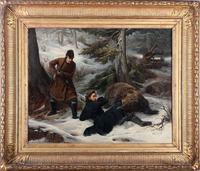
The Bear Hunters
Francois-Auguste Biard
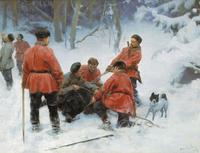
Capture of bear in the woods
Klavdy Lebedev
Wait. Let them come nearer
Vasily Vereshchagin
Contemplator
Ivan Kramskoy
Trapper in the Woods
Clarence Gagnon
Headed Duck hunter
Viktor Vasnetsov
Marshall Ney at Retreat in Russia
Adolphe Yvon
The Frontiersman Pupular Magazine cover Illustration
N.C. Wyeth
In Winter
Ivan Tvorozhnikov
Tukkinuotiolla
Pekka Halonen
Old soldier descending from the snowy mountain
Vasily Surikov
Ukrainian
Henryk Rodakowski
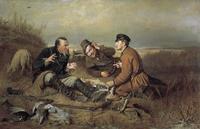
Hunters at rest
Vasily Perov
The Sentry
Gerolamo Induno
Soldiers in the snow
Vasily Vereshchagin
SOLDAT EN FORÊT
Basile Lemeunier
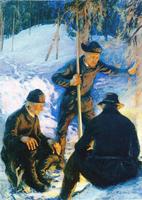
Tukkimiehiä Nuotiolla
Pekka Halonen
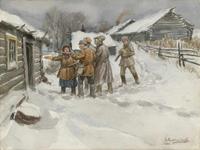
In Search of An Escaped Kulak
Ivan Vladimirov