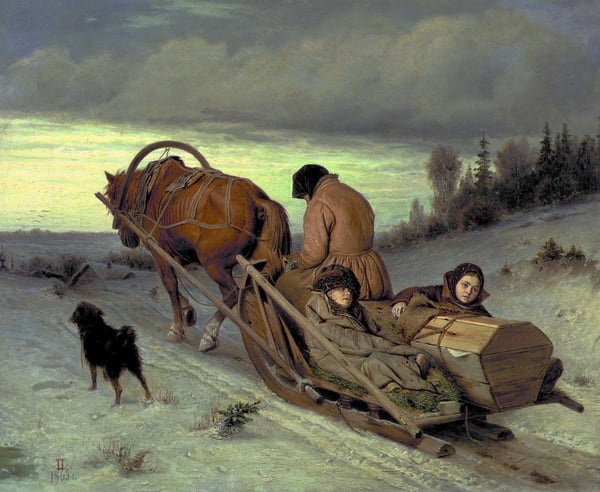
Expert analysis of Vasily Perov’s Last Journey
Style: Realism · Genre: genre painting
Vasily Perov’s Last Journey stands as a quintessential example of Russian Realism, a movement that sought to depict the unvarnished truths of everyday life—particularly the hardships of the peasantry and lower classes. As a genre painting, it places ordinary human experience at its center, rejecting idealized or historical subjects in favor of immediate, often poignant social commentary. The title alone evokes the somber finality of a funeral or migration, a theme Perov frequently used to critique societal neglect. His work is significant for its uncompromising focus on the emotional weight of mundane reality, aligning with the broader Realist mission to make art a vehicle for moral and social awareness. Within this context, Last Journey exemplifies how Perov transformed a simple, everyday event into a powerful reflection on mortality, class, and human resilience—hallmarks that solidified his role as a leading force in the Peredvizhniki (Wanderers) movement, which championed art accessible to the public and grounded in lived experience.
Museum / Gallery
Visually similar
20 works with related composition and palette
Empties
Illarion Pryanishnikov
Ice-Cutting
Konstantin Kryzhitsky
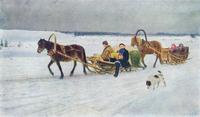
Farewell of a New Soldier
Nikolay Bogdanov-Belsky
H3145 L15125422
Sergei Semenovich Voroshilov
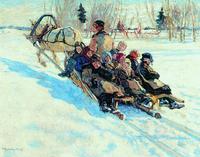
To school
Nikolay Bogdanov-Belsky
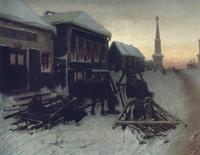
Last Tavern at Town Gate
Vasily Perov
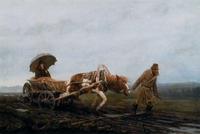
Off-road In Tver Province, Zemsky Doctor
Ivan Tvorozhnikov
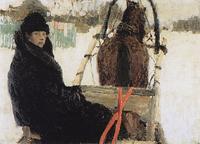
Coachman
Igor Grabar
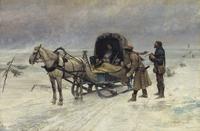
The Death of Sten Sture the Younger on the Ice of Lake Mälaren
Carl Gustaf Hellqvist
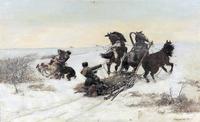
Scene
Bohdan von Kleczynski
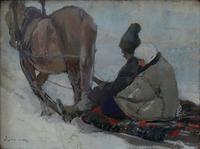
Girl's Dower
Arthur Verona
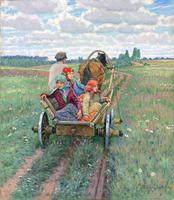
Coming after the daily work
Nikolay Bogdanov-Belsky
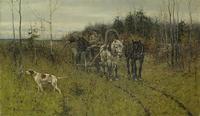
Hunting Scene
Sergei Semenovich Voroshilov
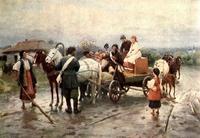
Весілля в Україні
Микола Пимоненко
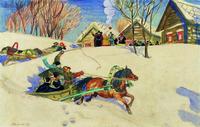
Shrovetide
Boris Kustodiev
Moonlight
Józef Chełmoński
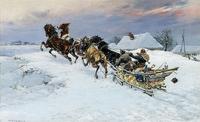
Wild Sleigh Ride
Bohdan von Kleczynski

Första besöket
Bengt Nordenberg

Novgorod. Returning from the fair.
Pyotr Konchalovsky
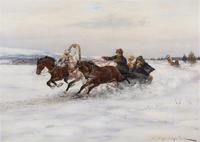
Troika in the snow
Sergei Semenovich Voroshilov