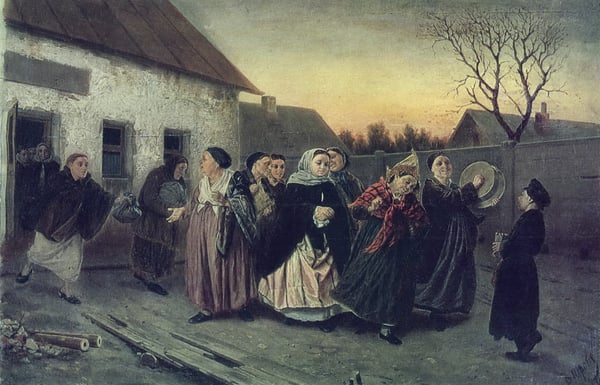
On the eve of bachelorette party. The bride from the bath
Details
Expert analysis of Vasily Perov’s On the eve of bachelorette party. The bride from the bath
Style: Realism · Genre: genre painting
Expert Art Historical Analysis
Artwork: On the Eve of Bachelorette Party. The Bride from the Bath (c. 1870s)
Artist: Vasily Perov (1834–1882)
Style: Realism
Genre: Genre painting
Significance within Realism and the Genre Tradition
Vasily Perov was a leading figure of the Russian Realist movement, a branch of 19th-century Realism that rejected romanticized or academic conventions in favor of unflinching portrayals of everyday life, often with social or moral critique. This painting is a prime example of his commitment to capturing authentic moments of ordinary people—a defining feature of the genre tradition.
The Scene’s Realist Core
The title reveals a private, ritualistic moment: a bride emerging from the bath on the eve of her bachelorette party. In Russian folk tradition, the bath (banya) was both a physical cleansing and a symbolic rite of passage—a prenuptial purification. Perov’s choice to depict this transitional instant—neither the festive party nor the wedding itself, but the quiet, intimate preparation—underscores Realism’s fascination with the unglamorous, the preparatory, and the human behind the ceremony.
What Makes It Significant
-
Democratization of Subject Matter – Like his contemporaries (e.g., Repin, Kramskoi), Perov elevated a peasant or lower-middle-class woman’s experience to the level of high art. The bride is not an idealized figure; she is shown in a moment of vulnerability, possibly tired or contemplative, surrounded by humble domestic details. This focus on the “anonymous” individual was revolutionary for its time.
-
Psychological Depth – The painting likely captures emotional ambiguity: anticipation, anxiety, farewell to girlhood. Realism’s strength lay in conveying inner states through posture, setting, and lighting—without overt sentimentality. Perov’s treatment of the bride’s expression (if depicted) would have been restrained, inviting the viewer to infer her thoughts.
-
Ethnographic Authenticity – The title’s specificity (“from the bath,” “on the eve of bachelorette party”) suggests Perov researched or observed actual rituals. This documentary impulse—recording customs of the Russian people—was a hallmark of the realist genre, aligning the painting with a broader cultural-nationalist project to preserve folk life.
-
Rejection of Academic Hierarchy – In the official Salon tradition, history painting and mythology reigned supreme. Perov’s decision to focus on a domestic pre-wedding ritual, with no moralizing allegory, was a direct challenge to those hierarchies. The work declares that a peasant bride’s bath is as worthy of artistic attention as a classical goddess.
Conclusion
This painting is significant as a quintessential Realist genre work: it captures a fleeting, culturally specific moment with psychological nuance and social awareness, while rejecting idealization. By documenting a private female rite with dignity and sobriety, Perov expands the scope of what art can represent—and whose stories it can tell.
Visually similar
20 works with related composition and palette
Helgal, Lootsen Family
Rudolf Jordan
Showing the Prize
George Harvey
Жертва фанатизму
Микола Пимоненко
The Poultry Market
Camille Pissarro
Three homeless children
Vladimir Makovsky
Vendor of Song Books
Vasily Perov
Leaving School
Honore Daumier
The prize-giving
Alexandre Antigna
Return from the Church Fair
Ferdinand Georg Waldmüller
Girlish Bbq
Alexei Korzukhin
Visiting a poor people
Vladimir Makovsky
On the Wedding Morning (The Bridal Adornment)
Henry Mosler
La Visita
Pasquale Celommi
Seen at Chelmusky, North Russia, When the Artist was on His Way to Pujos Gora with a Russian Force Under Colonel Kruglyakov.
Henry Tonks
Playmates
Viktor Vasnetsov
Daily scene
August Allebé
Regular pool
Vasily Perov
In winter
Daniel Ridgway Knight
Lucky with the ladies
Anders Zorn
Construction laborers receiving their breakfast
Ferdinand Georg Waldmüller