Analisi esperta di Triple di Vasily Perov
Stile: Realism · Genere: sketch and study
Expert Analysis of "Triple" by Vasily Perov
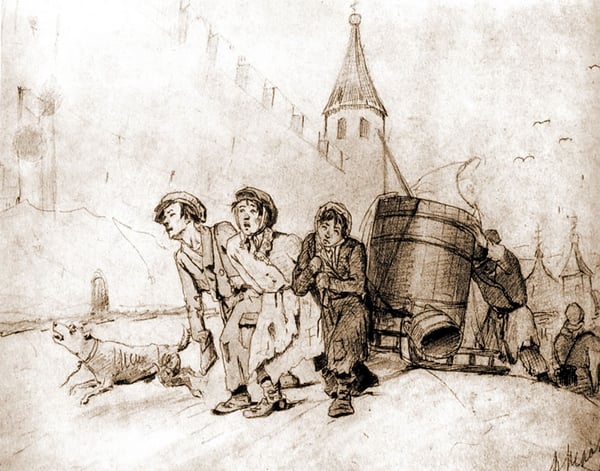
As a preparatory sketch or study for what is likely Perov’s renowned painting The Troika (also known as Apprentice Workmen Carrying Water, 1866), this work is a compelling example of Russian Realism’s commitment to unflinching social observation. Perov was a leading figure in the Peredvizhniki (The Wanderers) movement, which rejected academic idealism in favor of depicting the harsh realities of 19th-century Russian life. In Triple, we see the raw underpinnings of that mission.
Significance within Realism and Perov’s Oeuvre:
-
Documentary Intent: The study captures the specific, strained postures of child laborers harnessed to a heavy sledge. These children—exhausted, freezing, and bent against the wind—are not romanticized. Perov’s sketch preserves their individual physical struggle, making the final painting a powerful indictment of child exploitation. This aligns with Realism’s goal to present truth, not beauty.
-
Technical and Emotional Foundation: As a sketch, Triple reveals Perov’s working method: he prioritized anatomical accuracy and authentic gesture over finish. The loose, rapid handling of line and shading conveys movement and fatigue, while the absence of extraneous detail focuses attention on the children’s dire predicament. This rawness gives the study an immediacy that the more polished final painting may negotiate through color and narrative.
-
Social Critique: In the Russian Realist context, Perov’s works often exposed the failure of post-serfdom reforms to improve life for the poor. Triple (and its finished version) stands as a landmark of socially engaged art, directly influencing later artists like Repin. The study’s monochromatic, unadorned quality insists that even a mere sketch can carry profound moral weight—an essential tenet of the Realist ethos.
In summary, Triple is significant not only as a technical artifact of Perov’s creative process but as a testament to Russian Realism’s core principle: that art’s highest purpose is to bear witness to suffering and demand empathy.
Visivamente simili
20 opere con composizione e palette affini
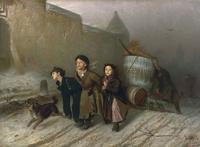
Troika. Apprentice Workmen Carrying Water
Vasily Perov
Drowned
Vasily Perov
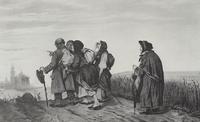
Pilgrims. On a pilgrimage
Vasily Perov
Accident on the Road
Piotr Michałowski
Nine Peasants Around a Wheelbarrow
Hendrick Avercamp
Going to church on sunday
Rudolf Jordan
The funeral of a poor quarter of Paris
Vasily Perov
Tramps
Konstantin Yuon
La Rue & Alsace
Julien Le Blant
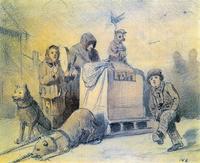
Street musicians in Paris
Vasily Perov
Scene in the Tavern
Adriaen van Ostade
Djelekovec rebellion
Ivan Generalic
The strolling musicians
Rembrandt
Melting Snow Maiden
Vasily Perov
Regular pool
Vasily Perov
Solitary and Bobylikha
Viktor Vasnetsov
Peer Gynt 04
Theodor Severin Kittelsen
Merchant festivities
Boris Kustodiev
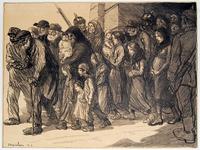
Les Interns - Sortie des geoles allemandes
Theophile Steinlen
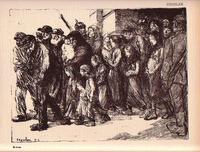
Les Otages Civils
Theophile Steinlen