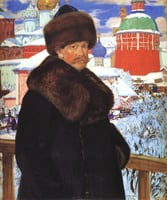
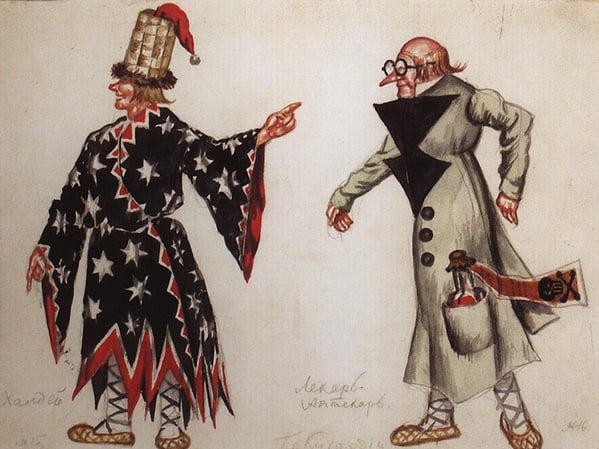
Doctor-pharmacist and a second Khaldei
Details
Expert analysis of Boris Kustodiev’s Doctor-pharmacist and a second Khaldei
Style: Art Nouveau (Modern) · Genre: design
Expert Analysis: "Doctor-pharmacist and a second Khaldei" by Boris Kustodiev
Although Boris Kustodiev is best known for his vivid portrayals of Russian provincial life and folk festivals, this work—categorized as Art Nouveau (Modern) in genre of design—reveals his engagement with the decorative and applied arts that defined the turn of the 20th century.
Significance within Art Nouveau and the Design Genre:
-
Applied Art Nouveau Aesthetic:
As a design piece, this work embodies the Art Nouveau principle of integrating fine art into functional or commercial objects. The stylized lines, probable rhythmic patterns, and emphasis on surface decoration are hallmarks of the style, which rejected historical revivalism in favor of organic, sinuous forms. Kustodiev’s adaptation of Art Nouveau to a subject featuring a “doctor-pharmacist” and a “second Khaldei” (likely a reference to a specific figure or type—possibly a Chaldean magician or astrologer) suggests a playful or allegorical narrative, typical of the period’s fascination with exotic, mystical, or historical themes. -
Russian Modernism and National Identity:
Kustodiev’s background in traditional Russian art, combined with this Modern design, demonstrates the cross-pollination between Russian folk motifs and international Art Nouveau. The presence of a pharmacist—a modern professional—paired with a mystical “Khaldei” mirrors the era’s tension between science and occultism, a common Art Nouveau trope that elevated the artisan and the symbolist image. -
Design as a Vehicle for Art Nouveau Ideals:
Art Nouveau sought to transform everyday life through art. In the “design” genre, this work likely served a practical purpose—perhaps a poster, book illustration, or commercial advertisement. Kustodiev’s ability to blend fine art with commercial design underscores the movement’s ambition to erase the boundary between high and low art. The artwork’s significance lies in its demonstration of how a master painter could channel a unified visual language into the broader culture, making Art Nouveau’s sinuous elegance accessible beyond the canvas.
Conclusion:
“Doctor-pharmacist and a second Khaldei” is significant as a Russian contribution to the international Art Nouveau design movement. It showcases Kustodiev’s versatility and the movement’s core mission: to infuse modern life with artistic beauty, symbolism, and a sense of the fantastical. As a design artifact, it expands our understanding of Kustodiev’s oeuvre beyond his celebrated narrative realism.
Visually similar
20 works with related composition and palette
Book of the Marquise. Illustration 5
Konstantin Somov
Courtiers
Nicholas Roerich
Mamyrov, the old deacon (Costume design for the opera "The Enchantress")
Mikhail Vrubel
Sketches of costumes for "Peer Gynt"
Nicholas Roerich
The third drunkard
Alexandre Benois
Petrushka. Costume design for Vatslav Nijinsky
Alexandre Benois
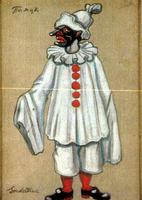
Costume designs for "Petrushka" by Stravinsky in Metropolitan Opera - Jester
Serge Sudeikin
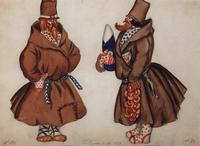
Guys from Tula
Boris Kustodiev
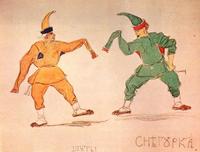
Jesters
Viktor Vasnetsov
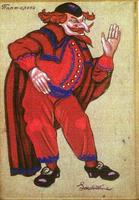
Costume designs for "Petrushka" by Stravinsky in Metropolitan Opera - Pantalone
Serge Sudeikin
Pierrot dancing
Edouard Manet
Don Juan, Sganarelle and the Beggar
Aubrey Beardsley
A coachman and a nurse.Costume design
Alexandre Benois
Designs of female costume
Boris Kustodiev
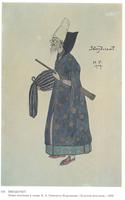
Costume design for the Opera, The Golden Cockerel, by Nikolai Rimsky-Korsakov
Ivan Bilibin
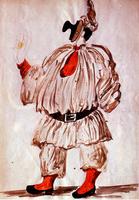
Design of costume for "Pulcinella"
Pablo Picasso
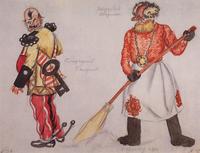
General and palace porter
Boris Kustodiev
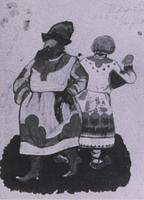
Sketch of costumes for "Snow Maiden"
Nicholas Roerich
Magician. Costume design
Alexandre Benois
Kiselvrode
Boris Kustodiev