Expertenanalyse zu Boris Kustodievs Irina Kustodieva
Stil: Realism · Genre: sketch and study
Analysis of "Irina Kustodieva" by Boris Kustodiev
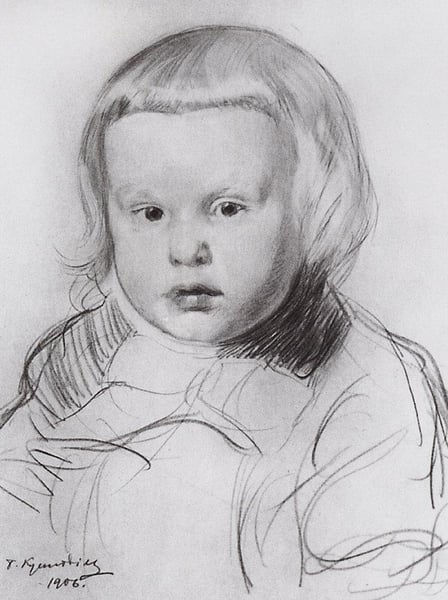
As a sketch and study executed in the Realist tradition, this work holds a unique place in Boris Kustodiev’s oeuvre—offering an intimate, unpolished glimpse into the artist’s process. Unlike his more famous, heavily detailed genre scenes and portraits, this study focuses on capturing the essential character and vitality of his subject, likely his daughter Irina, with a directness that finished works often lose.
Significance within Realism and Kustodiev’s Career:
- Process over polish: In Realism, sketches were vital for observing nature and life firsthand. Here, Kustodiev strips away the decorative richness for which he is known (the bright folk costumes, lush interiors) and instead concentrates on the sitter’s physical gesture and expression. The loose handling of paint or chalk reveals his hand in motion—evidence of a working method grounded in direct, honest observation.
- Familial intimacy: The subject being his own daughter adds a layer of psychological authenticity. This study feels unposed, capturing a fleeting moment of quiet attention or introspection. It demonstrates how Realism valued not just external truth, but the truth of personal connection.
- Artistic economy: As a study, it is significant for showing how Kustodiev built his compositions. The unfinished areas suggest he was experimenting with form, light, and shadow before committing to a final canvas. This piece thus serves as a rare document of his technical choices.
Stylistic observations: While still rooted in Realism’s fidelity to observation, the sketch exhibits a freedom that hints at later modern developments. The brushwork is confident but rapid, the modeling of the face is soft and evocative rather than hyper-detailed. This aligns with Kustodiev’s ability to shift between precise academic finish and the looser, more impressionistic approach typical of preparatory studies.
In summary, "Irina Kustodieva" is significant because it offers an unfiltered record of the artist’s eye in action—prioritizing life over artifice, and in doing so, revealing the core values of Realism: truth, observation, and emotional immediacy. It stands as a quiet counterpoint to Kustodiev’s celebrated masterworks, reminding us that even the grandest paintings begin with a simple, searching sketch.
Visuell ähnlich
20 Werke mit ähnlicher Komposition und Farbpalette
Fecteau
Kuzma Petrov-Vodkin
Nicolas Rubens
Peter Paul Rubens
Half-length portrait (Matthias Gabriel Lory Jr.?)
Franz Ludwig Catel
Drawing for the portrait to His Royal Highness Vittorio Emanuele
Romualdo Locatelli
Nicolas Rubens
Peter Paul Rubens
Vincent Willem Van Gogh
Isaac Israels
Portrait of Ellen Mary Cassatt
Mary Cassatt
The daughter of an artist
Kuzma Petrov-Vodkin
the Artists Daughter Ila
Albin Egger-Lienz
Portrait of a Little Girl
Tsuguharu Foujita
Flora Currin
John Currin
Portrait of a girl
Anton Azbe
Solon boy
Vasily Vereshchagin
Head Of Child
Andrea del Sarto
Portrait of Jean Renoir
Pierre-Auguste Renoir
Volto di bambino
Tito Lessi
Portrait of a girl
Wenzel Tornøe
Master John Parsons Millet
Sir Lawrence Alma-Tadema
Portrait of a Girl
Gerda Wegener
Portrait Drawing of George
Martin Yeoman