
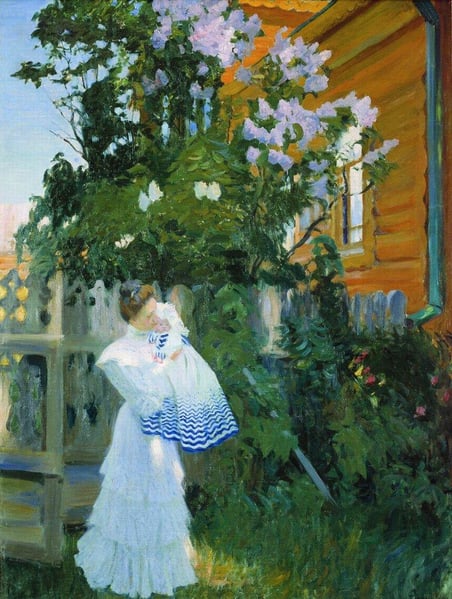
Boris Kustodiev sanatçısının Lilacs eseri hakkında uzman analizi
Tarz: Impressionism · Tür: genre painting
Expert Analysis of "Lilacs" by Boris Kustodiev
Boris Kustodiev’s Lilacs stands as a vibrant testament to the artist’s ability to merge the luminous, color-driven principles of Impressionism with a distinctly Russian sense of national identity and an intimate, genre-painting focus on everyday life. Although Kustodiev is often associated with his later, more decorative depictions of merchant-class festivities and folk celebrations, Lilacs exemplifies his earlier and ongoing fascination with the fleeting, sensory pleasures of nature and domestic tranquility—a hallmark of Impressionist genre painting.
Significance within Impressionism:
Kustodiev’s interpretation of Impressionism is less concerned with the systematic optical analysis of light than with a rich, tactile celebration of color and texture. In Lilacs, he likely employs a palette of violets, purples, and greens, broken into short, varied brushstrokes that capture the shimmering, almost tactile quality of the blossoms. This approach aligns with the Impressionist goal of recording a momentary perception, but Kustodiev infuses it with a decorative, almost folk-art boldness. The painting’s significance lies in how it adapts Western European Impressionist techniques—such as open composition and the play of natural light on surfaces—to a Russian subject matter, creating a hybrid that is both cosmopolitan and deeply local.
Significance within the Genre Painting Tradition:
As a genre painting, Lilacs elevates a simple, private moment—perhaps a woman gathering flowers or a vase of freshly cut lilacs on a sunlit table—into a scene of serene, universal beauty. Kustodiev, who suffered from a debilitating spinal condition that confined him to a wheelchair for much of his career, often channeled his longing for vitality into images of lush, sensuous life. Lilacs therefore becomes more than a botanical study; it is an expression of joy and resilience. The work’s significance is heightened by its focus on the ephemeral bloom of spring, a metaphor for fleeting happiness and the artist’s own determination to capture beauty despite physical limitation.
Overall Artistic Contribution:
Lilacs occupies a crucial place in Kustodiev’s oeuvre as a bridge between the pure Impressionism of his early training (under Ilya Repin and at the Imperial Academy of Arts) and the more stylized, almost theatrical realism of his mature period. It demonstrates that even within a borrowed international style, a Russian artist could produce a work that feels authentically homegrown—rooted in the rhythms of provincial life, the love of saturated color, and a deep emotional connection to nature. The painting’s enduring appeal lies in its ability to communicate a vivid, unforced sense of delight, making it a significant example of how Impressionist principles were reimagined in a Russian context.
Görsel olarak benzer
İlişkili kompozisyon ve renk paletine sahip 20 eser
May Flowers
Victor Borisov-Musatov
In the Garden
Konstantin Makovsky
Portrait of Mrs N.F. Ober
Konstantin Somov
Summertime
Konstantin Korovin
Repose at Sunset
Konstantin Somov
Long Distance
Haddon Sundblom
Summertime. Portrait of Olga Serova
Valentin Serov
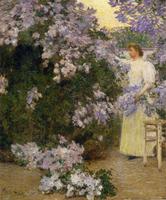
Mrs. Hassam in the Garden
Childe Hassam
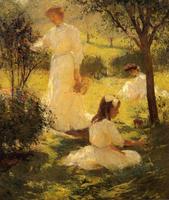
Girls in the Garden
Frank W. Benson
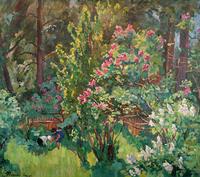
Children in the Park
Pyotr Konchalovsky

A Young Girl with a Straw Hat, Dressed in a White Summer Dress
Hans Andersen Brendekilde
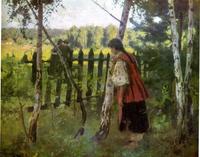
Ревнощі
Микола Пимоненко
Laddie
Frank W. Benson
Landscape with a Fence
Konstantin Gorbatov
Portrait of the artist's wife, Olga Konchalovskaya. Under the umbrella in the garden.
Pyotr Konchalovsky
The Child`s Caress
Mary Cassatt
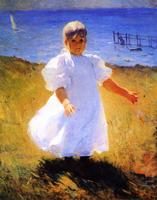
Child in Sunlight
Frank W. Benson
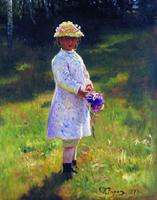
Girl with Flowers. Daughter of the Artist.
Ilya Repin
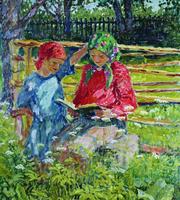
Girls in Kerchiefs
Nikolay Bogdanov-Belsky
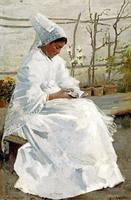
Communion Day
Edward E. Simmons