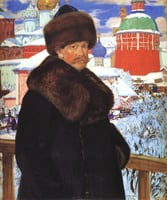
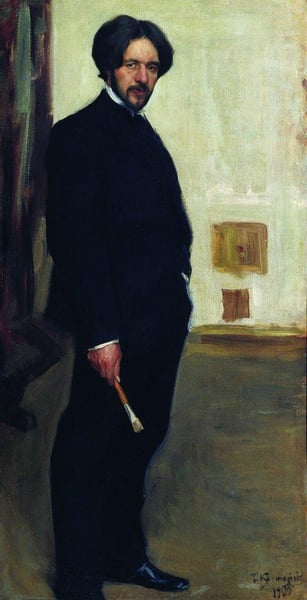
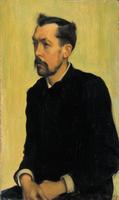
Analisi esperta di Portrait of D.F. Bogoslovsky di Boris Kustodiev
Stile: Realism · Genere: portrait
Expert Art Historical Analysis: Portrait of D.F. Bogoslovsky by Boris Kustodiev
Boris Kustodiev (1878–1927) is celebrated for his vibrant, often nostalgic depictions of Russian life—merchant festivals, provincial fairs, and lush, sun-drenched taverns. Yet his realist portraits reveal a different, equally masterful facet of his oeuvre: a profound psychological acuity grounded in the traditions of 19th-century Russian Realism.
Significance within Realism and the Portrait Genre
In Portrait of D.F. Bogoslovsky, Kustodiev steps away from his signature decorative ornamentalism and instead channels the sober, observational rigor of the Peredvizhniki (The Wanderers)—the realist movement that dominated Russian painting before the turn of the century. The work is significant because it demonstrates how Kustodiev, even as he later embraced a more colorful, almost folk-vernacular style, remained capable of the unflinching character study that defines high Realism.
The portrait’s importance lies in its fusion of meticulous detail with a palpable inner life. Kustodiev’s handling of light and texture—likely evident in the sitter’s clothing, facial features, and background—grounds the subject in a specific social and historical moment. Realism demands truth to appearance, but Kustodiev goes further: he captures the psychological weight of his sitter, a reflection of the artist’s own commitment to rendering not just how people looked, but who they were within the rapidly changing Russian society of the early 20th century.
Why It Matters
Portrait of D.F. Bogoslovsky stands as a testament to Kustodiev’s versatility. While he is often pigeonholed as a painter of joyous, bustling scenes, this portrait anchors him firmly within the realist tradition’s core mission: to document human character with honesty and empathy. It also bridges Kustodiev’s early training under Ilya Repin—the master of psychological realism—and his later, more stylized works. In this sense, the portrait is a key transitional piece, showing the artist’s unwavering focus on the dignity and complexity of his subjects, even as his style evolved. For viewers, it offers a quiet, intimate counterpart to the exuberance of his more famous canvases, revealing the depth of an artist too often reduced to color and carnival.
Visivamente simili
20 opere con composizione e palette affini
Portrait of the Artist Vasily Surikov
Valentin Serov
Portrait of George W. Vanderbilt
James McNeill Whistler
Fragment of a smiling self-portrait at full length
Richard Gerstl
Portrait of Paul Alexandre
Amedeo Modigliani
The artist Igor Grabar
Filipp Malyavin
Study for the Portrait of F. R. Leyland
James McNeill Whistler
Edward Guthrie Kennedy
James McNeill Whistler
Self-Portrait with Brushes
Edvard Munch
Portrait of Leopold Zborowski
Amedeo Modigliani
Seated Young Man in a Jacket with an Umbrella
Edgar Degas
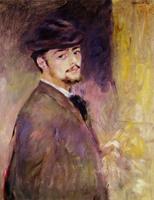
Self-Portrait at the Age of Thirty Five
Pierre-Auguste Renoir
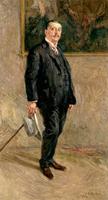
Portrait of Giacomo Campagnano
Umberto Veruda
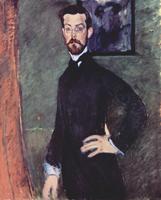
Portrait of Paul Alexander on green background
Amedeo Modigliani
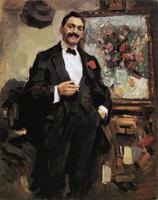
Portrait of a Hungarian artist József Ripley Ronai
Konstantin Korovin
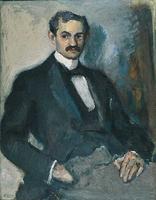
Portrait of a man
George Bouzianis
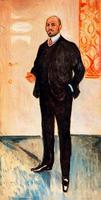
Walter Rathenau
Edvard Munch
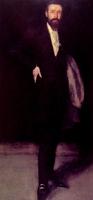
Arrangement in Black: Portrait of F.R. Leyland
James McNeill Whistler
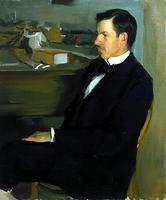
Portrait of M.I. Heylik
Boris Kustodiev
Francis Poictevin
Jacques-Émile Blanche
Portrait of Jean Daurelle
Gustave Caillebotte