Expertenanalyse zu Boris Kustodievs The Consecration of Water on the Theophany
Stil: Art Nouveau (Modern) · Genre: genre painting
Expert Analysis: "The Consecration of Water on the Theophany" by Boris Kustodiev
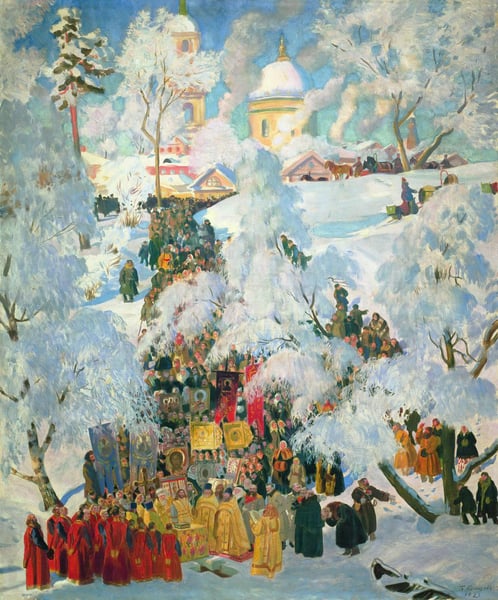
This artwork is a vivid example of how the Art Nouveau (Modern) style—characterized by sinuous lines, ornamental detail, and a flattened sense of space—can be applied to a traditional Russian genre scene. Kustodiev, working within the Art Nouveau idiom, transforms a religious and communal ritual into a decorative, almost theatrical tableau.
What makes the work significant within its period and style:
-
Synthesis of Decorative and Folk Elements: While Art Nouveau often drew on curvilinear, natural motifs from Western Europe (e.g., the work of Alphonse Mucha or Hector Guimard), Kustodiev infuses the style with distinctly Russian Orthodox and folk iconography. The scene—the consecration of water on the Feast of Theophany (Epiphany)—is a deeply rooted Eastern Orthodox tradition. Kustodiev renders it not with solemn realism but with a bright, patterned palette and rhythmic composition that echo the decorative arts of his time. The crowded, bustling crowd, the glint of gold on priestly vestments, and the crisp winter snow all become part of an ornamental surface.
-
Genre Painting as Cultural Statement: As a genre painting, the work captures a slice of everyday life, but Kustodiev elevates it beyond simple documentation. The significance lies in how he uses Art Nouveau’s emphasis on stylization to celebrate Russian identity. The figures are arranged in a frieze-like manner, their poses slightly exaggerated—a hallmark of the Modern style—which lends the ritual a sense of timeless, ritualistic pageantry rather than spontaneous realism. This approach aligns with the early 20th-century revival of interest in national folklore and traditional crafts (e.g., Russian lubok prints and icon painting), which Kustodiev updates through an Art Nouveau lens.
-
Contrast with European Art Nouveau: While many Art Nouveau artists focused on ethereal, idealized women or florid interiors, Kustodiev grounds his ornamentalism in the material world of a winter riverbank. The “consecration” itself—a priest blessing a hole cut in the ice—becomes a spectacle of swirling furs, colored scarves, and snow-laden trees. The work is significant for proving that Art Nouveau could accommodate narrative, communal, and even sacred subject matter without losing its characteristic decorative flair. It is a rare fusion of fin-de-siècle modernity with enduring Orthodox tradition.
In sum, Kustodiev’s painting is a masterful bridge: it applies the sophisticated, linear elegance of Art Nouveau to a quintessentially Russian genre scene, thereby asserting that modernism could be both national and sacred. The work stands as a testament to the flexibility of the Art Nouveau style beyond its typical Western European contexts.
Museum / Gallery
Visuell ähnlich
20 Werke mit ähnlicher Komposition und Farbpalette
Saint Russia
Mikhail Nesterov
Sunday
Andrei Ryabushkin
Shrove-Tide
Boris Kustodiev
Shrovetide
Boris Kustodiev
Christmas tree bargain
Boris Kustodiev
Arriving for Shrovetide
Boris Kustodiev
Easter Procession
Illarion Pryanishnikov
Fist fight on the Moscow River
Boris Kustodiev
Exit of Tsar Ivan the Terrible
Boris Kustodiev
Martha the Mayoress. Destruction of Novgorod by Ivan III.
Klavdy Lebedev
Merchant's yard
Boris Kustodiev
The burning of Archpriest Avvakum
Grigoriy Myasoyedov
Hermit fathers and immaculate women
Mikhail Nesterov
Monastery in the snow
Konstantin Yuon
Boyarynya Morozova
Vasily Surikov
Boyarynya Morozova (study)
Vasily Surikov
Taking a snowy town
Vasily Surikov
Moscow Street of XVII Century
Andrei Ryabushkin
Dancing
Klavdy Lebedev
Shrove-Tide
Boris Kustodiev