Analisi esperta di The guy from Tula di Boris Kustodiev
Stile: Art Nouveau (Modern) · Genere: design
This analysis is based exclusively on the provided structured facts.
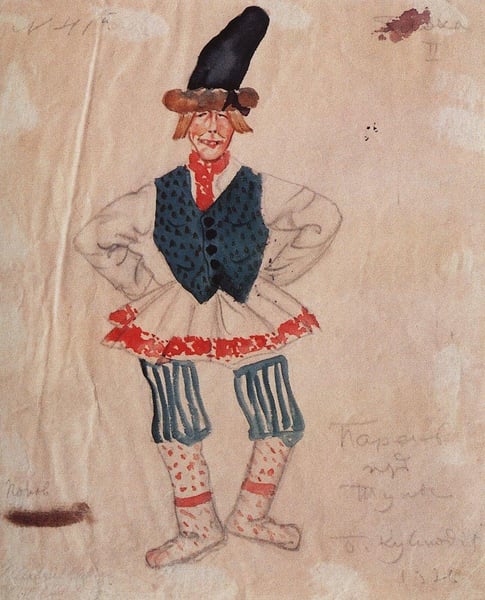
Artwork: The guy from Tula
Artist: Boris Kustodiev
Style: Art Nouveau (Modern)
Genre: Design
Expert Description and Significance
Boris Kustodiev’s The guy from Tula stands as a notable example of Art Nouveau applied to the design genre, demonstrating how the movement’s decorative vocabulary could be fused with regional Russian identity. While Kustodiev is often associated with vivid scenes of Russian provincial life, this work reframes that heritage through the lens of Modernist ornament.
Stylistic Significance (Art Nouveau):
The piece likely employs Art Nouveau’s signature sinuous, flowing lines—often termed the “whiplash” curve—to structure the composition. As a design work (rather than a narrative painting), it prioritizes rhythmic pattern over naturalistic detail. The figure of a Tula man would be stylized into an elegant silhouette or flat decorative motif, echoing the movement’s preference for two-dimensional abstraction. This aligns Art Nouveau’s international aesthetic with a distinctly Russian subject, making the work a hybrid of cosmopolitan modernism and local folklore.
Context of Tula:
Tula, a historic city south of Moscow, is famed for its samovars, armaments, and gingerbread. By selecting a “guy from Tula,” Kustodiev grounds his design in a recognizable archetype—likely a craftsman or merchant—whose costume and posture would be simplified into ornamental lines. This choice bridges the gap between high-art decoration and vernacular culture, a hallmark of Art Nouveau’s desire to elevate everyday life through design.
Modern Genre Implications:
The classification as “design” underscores the work’s intended function: it may have been conceived as a poster, a book illustration, a stained-glass cartoon, or a textile pattern. In this capacity, The guy from Tula participates in Art Nouveau’s radical mission to erase boundaries between fine arts and applied arts. Its significance lies in how it translates a recognizable character into a purified, stylized emblem—a move that anticipates the modern graphic poster and the commercial art of the early 20th century.
In summary, the artwork is significant for synthesizing Art Nouveau’s organic, modern aesthetic with Russian regional imagery, thereby demonstrating the style’s adaptability beyond Western European centers and its power to transform a folk figure into a timeless design statement.
Visivamente simili
20 opere con composizione e palette affini
Hamlet
John Austen
Petrushka. Costume design for Vatslav Nijinsky
Alexandre Benois
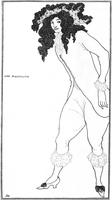
Mrs Pinchwife Country Wife by Wycherley
Aubrey Beardsley
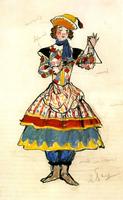
Street Dancer. Costume design
Alexandre Benois
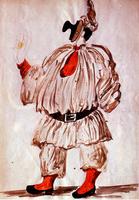
Design of costume for "Pulcinella"
Pablo Picasso
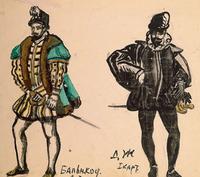
Costume design for the opera Don Giovanni by Wolfgang Amadeus Mozart, 'Don Giovanni'
Pyotr Konchalovsky
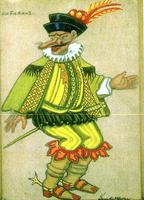
Costume designs for "Petrushka" by Stravinsky in Metropolitan Opera - Capitain
Serge Sudeikin
Pierrot dancing
Edouard Manet
Thiers
Honore Daumier
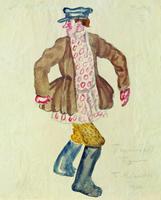
The guy from Tula
Boris Kustodiev
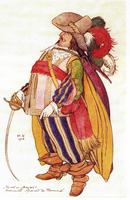
Sketch for the spectacle, Honor and Revenge, by Fiodor Sollogub
Ivan Bilibin
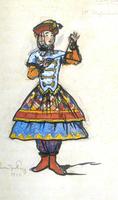
First barrel organ player. Costume design
Alexandre Benois
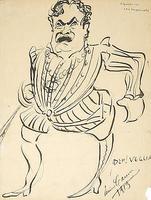
Singing 'Deh Veglia'
Enrico Caruso
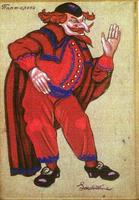
Costume designs for "Petrushka" by Stravinsky in Metropolitan Opera - Pantalone
Serge Sudeikin
A guy, Gegstad
Nicholas Roerich
Costume designs for "Petrushka" by Stravinsky in Metropolitan Opera - Jester
Serge Sudeikin
Costume design for ballet "Tricorne"
Pablo Picasso
Hay Ay Que Me Canso
Rosario Weiss Zorrilla
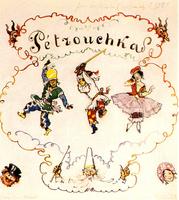
Petrushka. Poster scetch
Alexandre Benois
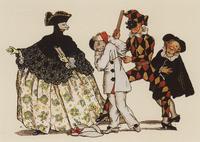
Book of the Marquise. Illustration 5
Konstantin Somov