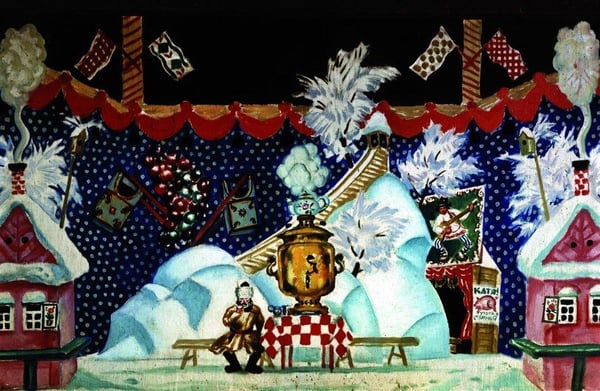
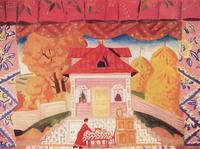
Based solely on the provided facts, the significance of Boris Kustodiev's "View in Tula, a sketch for E. Zamyatin's play, 'The Flea'" lies in its embodiment of Art Nouveau (Modern) principles within the design genre, specifically applied to theatrical production.
As a sketch for a stage design, the artwork demonstrates how the Art Nouveau style—known for its emphasis on organic, flowing lines, decorative surfaces, and a synthesis of the arts—was adapted for narrative and performance spaces. The fact that it is a preparatory work for a play by a notable literary figure (E. Zamyatin) underscores the interdisciplinary nature of the period: visual artists, writers, and stage designers often collaborated to create unified modern experiences.
Within the context of Art Nouveau, this work is significant because it shows the style moving beyond mere graphic or architectural decoration into functional, imagined environments. The sketch for "The Flea" exemplifies how a modern designer could reinterpret a literary text through the lens of ornament and stylization, making the artwork a key document of how Art Nouveau aesthetics shaped the visual language of early 20th-century theatre.