
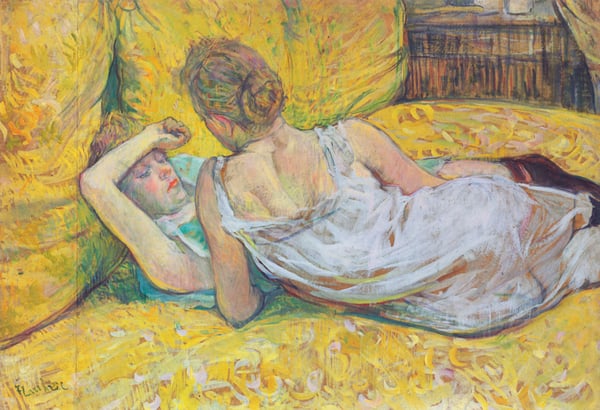
Analisi esperta di Abandonment (The pair) di Henri de Toulouse-Lautrec
Stile: Post-Impressionism · Genere: genre painting
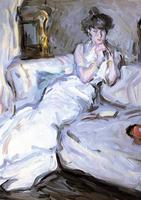
The significance of Henri de Toulouse-Lautrec’s Abandonment (The pair) lies in its intimate, psychologically charged take on a supposedly mundane genre scene, executed through the distinctive visual language of Post-Impressionism. Although the painting depicts an ordinary moment between two figures, Toulouse-Lautrec transforms it into a commentary on transience and emotional isolation—themes he explored throughout his chronicles of Parisian nightlife and society’s margins.
Key aspects of its significance:
-
Emotional immediacy over narrative: Unlike traditional genre painting that often tells a clear story, Toulouse-Lautrec freezes a fleeting, ambiguous interaction. The title “Abandonment” suggests loss or separation, but the artist avoids overt sentimentality, instead letting the figures’ body language and spatial composition—likely a pronounced diagonal or off-center arrangement—convey a sense of estrangement. This aligns with Post-Impressionism’s shift toward subjective emotional truth rather than objective realism.
-
Expressive line and compressed space: True to his style, Toulouse-Lautrec would have used sharply outlined forms and flattened perspective, borrowing from Japanese ukiyo-e prints. In Abandonment, such devices heighten the tension between the pair, forcing the viewer to focus on the psychological gulf between them rather than surrounding details.
-
Social observation through modern life: While Toulouse-Lautrec is celebrated for his posters of dance halls and brothels, Abandonment shows his equal mastery of quiet, private dramas. It anticipates the loneliness that pervades much 20th-century figurative art, making it a precursor to the emotional realism of artists like Edvard Munch or even the early work of Pablo Picasso.
Within the Post-Impressionist movement, this painting stands out because it does not rely on the bold color experiments of Seurat or Gauguin, but rather on a stark, almost theatrical economy of means—demonstrating that the movement’s innovations could be just as powerful in capturing the fragile rhythms of human connection as in exploding color theory.
Museum / Gallery
Visivamente simili
20 opere con composizione e palette affini
In the Hotel Room
Jules Pascin
Vera Reclining
Matthew Smith
Young Girl with Flower
Émilie Charmy
Nude in the Thalamus
Nicolae Tonitza
Siesta
Jules Pascin
Bacchante
Joaquín Sorolla
The Studio of Ingres
Victor Pasmore
Getting Up
Berthe Morisot
The Kiss
Henri de Toulouse-Lautrec
Nu Au Fauteuil
Henri Matisse
The Bed
Henri de Toulouse-Lautrec
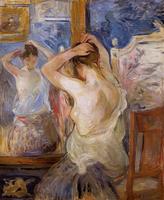
Before the Mirror
Berthe Morisot
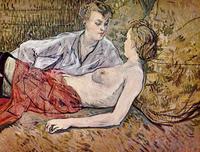
Two Friends
Henri de Toulouse-Lautrec
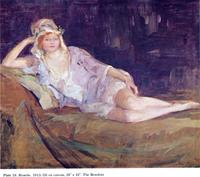
Rosette
John French Sloan
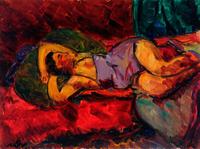
Reclining Nude. The Mauve Chemise
Matthew Smith
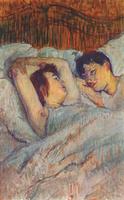
In Bed
Henri de Toulouse-Lautrec
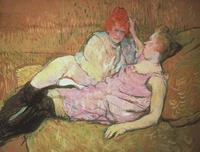
The Sofa
Henri de Toulouse-Lautrec
Rest
Edgar Degas
Czobel Béla Women.
Bela Czobel
Girl in White
Samuel Peploe