
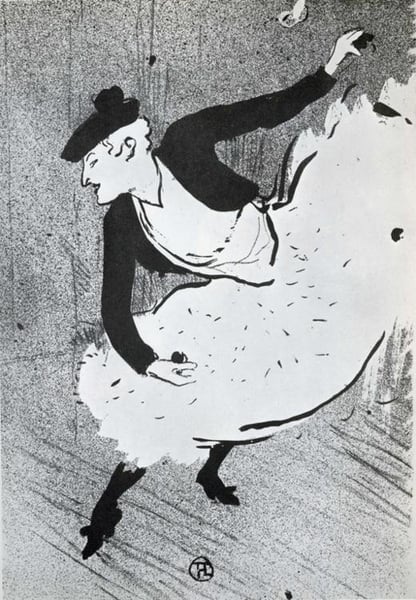
Edmee Lescot in Spanish Dancer Edmee Lescot have a Spanish Dancer
Henri de Toulouse-Lautrec sanatçısının Edmee Lescot in Spanish Dancer Edmee Lescot have a Spanish Dancer eseri hakkında uzman analizi
Tarz: Art Nouveau (Modern) · Tür: genre painting
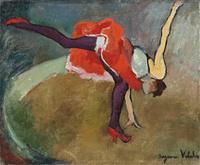
This artwork—Edmée Lescot as a Spanish Dancer (the corrected title from the given data)—by Henri de Toulouse-Lautrec holds a distinctive place within the Art Nouveau movement and the genre of modern life painting. The painting captures a performer, likely from the vibrant cabaret scene of Montmartre, adopting the persona of a Spanish dancer—a popular trope in Parisian entertainment that blended exoticism with theatrical flair.
Significance within Art Nouveau (Modern):
Toulouse-Lautrec’s work epitomizes the Art Nouveau fascination with decorative linearity and flattened planes of color, often borrowed from Japanese ukiyo-e prints. In this piece, the sinuous contours of the dancer’s costume and the rhythmic flow of her pose would typify the style’s emphasis on organic, whiplash lines. The bold simplification of form—eschewing detailed realism for expressive silhouette—aligns with the modern, poster-like aesthetic that Toulouse-Lautrec pioneered. His ability to distill movement and character into a few decisive strokes made him a master of the modern visual language, influencing later graphic design and commercial art.
Genre Painting and Cultural Context:
As a genre painting, it documents a specific social type: the performer who straddles the line between high art and popular entertainment. Edmée Lescot, a known model and actress, here embodies the Spanish danzarina—a role that allowed Toulouse-Lautrec to explore themes of identity, performance, and the fleeting spectacle of nightlife. The work is significant because it captures not just a moment but the entire fin-de-siècle Parisian obsession with theatrical illusion. By focusing on a real person in a staged role, Toulouse-Lautrec blurs the boundary between genuine portraiture and theatrical recreation, making the painting a commentary on the constructed nature of modern identity.
Artistic Technique:
Evoking his characteristic use of oil (or thinned paint on cardboard), the composition likely employs a restricted palette with dramatic contrasts—perhaps the reds and blacks of a Spanish costume set against a muted background. The quick, sketchy handling of the brushwork conveys both the spontaneity of a live performance and the artist’s signature economy of means. This technique, combined with the Art Nouveau stylization, elevates a seemingly casual genre scene into a sophisticated study of line, color, and modern life.
In sum, Edmée Lescot as a Spanish Dancer is significant for how it synthesizes Toulouse-Lautrec’s keen observation of Parisian society with the decorative innovations of Art Nouveau, making a simple performer’s portrait an enduring icon of the era’s visual culture.
Görsel olarak benzer
İlişkili kompozisyon ve renk paletine sahip 20 eser
Dancer in the Mirror
Max Pechstein
Anna Margit, Balerina
Anna Margit
Dance
Ernst Ludwig Kirchner
Anna Margit, Táncosnők
Anna Margit
Anna Margit, Balerina, 1941
Anna Margit
Jane Avril
Henri de Toulouse-Lautrec
Dancers
Tsuguharu Foujita
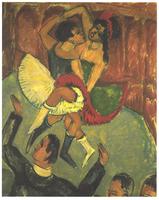
Dance of Negros
Ernst Ludwig Kirchner
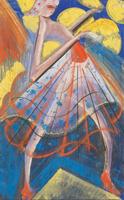
Scheiber Hugó, Táncosnő,.
Scheiber Hugó
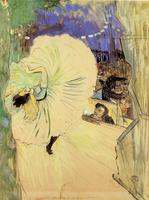
The Cartwheel
Henri de Toulouse-Lautrec
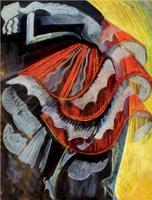
Scheiber Hugó, Táncolo
Scheiber Hugó
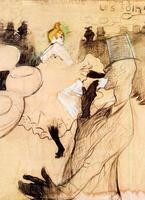
The Goulue and Valentin, The Boneless One
Henri de Toulouse-Lautrec
from Thorheiten
Thomas Theodor Heine
Dancer
Henri Matisse
Dancing Couple
Ernst Ludwig Kirchner
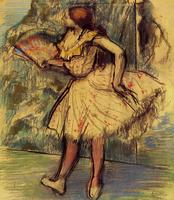
Dancer with a Fan
Edgar Degas
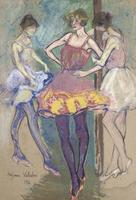
Three Dancers
Suzanne Valadon
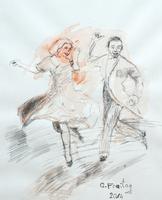
Ginger and Fred 1
Gazmend Freitag
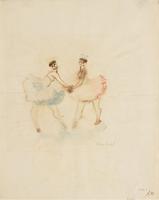
Anna Margit, Táncosnők 1
Anna Margit
The Acrobat
Suzanne Valadon