
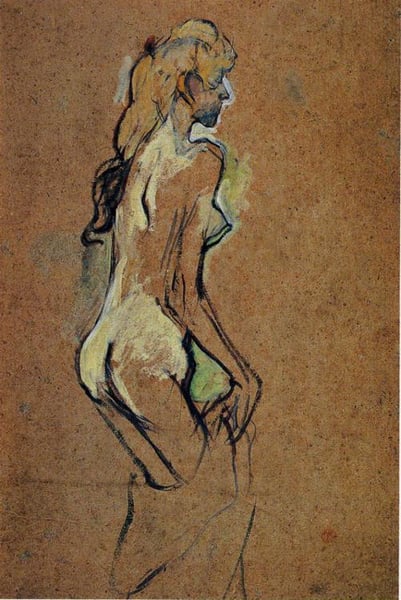
Analisi esperta di Nude Girl di Henri de Toulouse-Lautrec
Stile: Art Nouveau (Modern) · Genere: nude painting (nu)
Expert Analysis: "Nude Girl" by Henri de Toulouse-Lautrec
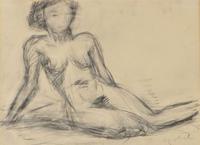
This intimate study of a female nude exemplifies Toulouse-Lautrec’s radical departure from the idealized, mythological nudes of academic painting. While categorized under Art Nouveau—a style known for its sinuous lines, organic forms, and decorative elegance—Toulouse-Lautrec infuses the genre with a raw, unvarnished immediacy that sets his work apart.
Significance within the Art Nouveau / Modern Context:
- Rejection of Idealization: Unlike classical nudes that present the female form as a perfected, distant object, Toulouse-Lautrec captures his model in a candid, unposed moment. The figure is shown with anatomical honesty—slumped shoulders, natural curves, and an unglamorous posture—emphasizing vulnerability and humanity over aesthetic beauty.
- Expressive, Decorative Linework: The artist employs the flowing, rhythmic contours typical of Art Nouveau, but he subverts their usual decorative purpose. Here, the line delineates not just form but psychological presence. The economy of line—often stark, sketch-like, and minimal—creates a sense of spontaneity and directness, as if the viewer has stumbled upon a private scene.
- Flatness and Modern Composition: Toulouse-Lautrec flattens the pictorial space, reducing background detail to abstract patches of color. This aligns with Art Nouveau’s affinity for two-dimensional design, but it also forces attention onto the model’s body. The shallow depth and asymmetrical cropping (influenced by Japanese ukiyo-e prints) give the composition a modern, snapshot-like quality.
- Psychological Nuance: Unlike many contemporary nudes that serve as mere vehicles for sensuality, Toulouse-Lautrec’s model possesses a quiet, introspective presence. Her gaze is averted, her body language withdrawn—a marked contrast to the performative eroticism of the era. This introspective quality reflects the artist’s deep empathy for his subjects, many of whom were working-class women or performers from the Montmartre demimonde.
- Break with Academic Tradition: At a time when the nude was still dominated by Salon conventions, Toulouse-Lautrec’s “Nude Girl” asserts that modernity lies in truthfulness. He captures the body as it is, in the private, unguarded moments of daily life—a legacy inherited from Degas but sharpened by Lautrec’s own caustic, compassionate eye.
Conclusion:
“Nude Girl” is significant because it bridges the ornamental elegance of Art Nouveau with the gritty realism of modern life. It challenges the viewer to see the nude not as a timeless symbol but as a specific, living individual, rendered with both stylistic sophistication and profound human insight. Toulouse-Lautrec’s work here anticipates the psychological depth and formal experimentation of early 20th-century modernism.
Museum / Gallery
Visivamente simili
20 opere con composizione e palette affini
Nude
Bela Czobel
Artist's Model from the back
Kuzma Petrov-Vodkin
Modok Mária, Akt Tanulmány
Modok Mária
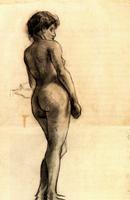
Standing Female Nude Seen from the Back
Vincent van Gogh
Czóbel Béla Nude 1941
Bela Czobel
CZbel Bela Fürdés Után
Bela Czobel
Berény Robert, Study of Nude 1910
Berény Róbert
Nude Model with Drapery
Maurice Prendergast
A standing nude
Jan Sluyters
Czóbel Béla Akt
Bela Czobel
Standing Female Nude Seen from the Back
Vincent van Gogh
Béla Czóbel Female Nude
Bela Czobel
Couple
Ernst Ludwig Kirchner
The Nymph
Karl Bryullov
Life Drawing – Woman
Jack Bush
female nude studies, a mid-body
Luc-Olivier Merson
Nude Sitting Back
Bela Czobel
Venus
Boris Kustodiev
Emerging from the bath
Zinaida Serebriakova
Nude Sitting
Bela Czobel