
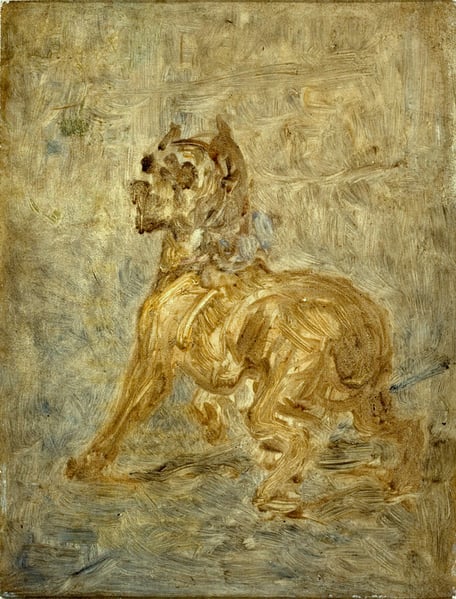
Expert analysis of Henri de Toulouse-Lautrec’s The Dog (Sketch of Touc)
Style: Impressionism · Genre: animal painting
Expert Analysis: "The Dog (Sketch of Touc)" by Henri de Toulouse-Lautrec
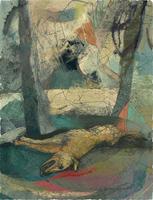
This intimate animal study, executed in the style of Impressionism, offers a rare glimpse into the personal world of Henri de Toulouse-Lautrec—an artist best known for his vibrant, often decadent portrayals of Montmartre's cabarets, dancers, and prostitutes. Here, however, the subject is his own dog, Touc, rendered with a spontaneous, sketch-like quality that reveals the artist's acute observational eye and his debt to Impressionist principles.
Significance within the Impressionist Style: The work epitomizes core Impressionist concerns: capturing a fleeting moment and the essential character of the subject through rapid, visible brushwork and a focus on light and atmosphere. Despite being an animal portrait, the painting avoids stiff formality. Instead, Toulouse-Lautrec prioritizes movement and gesture—the cock of the head, the alert posture, the soft contour of the body—using loose, economical strokes that suggest rather than define. The "sketch" designation is key; it underscores the Impressionist value of plein air immediacy and the belief that a quick observation can be more truthful than a polished studio piece.
Significance within Toulouse-Lautrec’s Oeuvre and the Animal Painting Genre: While Toulouse-Lautrec is celebrated for his human figures and scenes of Parisian nightlife, "The Dog (Sketch of Touc)" expands our understanding of his range and emotional depth. It demonstrates that his sensitivity to personality and mood extended to animals, proving that his signature psychological insight was not limited to people. This piece is significant because it personalizes the artist—reminding us that behind the flâneur and chronicler of modernity was a man with a beloved pet, captured with the same unflinching tenderness he applied to his human subjects.
Moreover, within the Impressionist movement, animal paintings were less frequent than landscapes or figure studies. Toulouse-Lautrec’s treatment of Touc elevates the genre: the dog is not a mere accessory or symbol, but an individual with presence. The sketchy technique also aligns with contemporary trends in Japanese woodblock prints, which influenced many Impressionists to value simplicity and line over detail. In this sense, "The Dog (Sketch of Touc)" is a microcosm of the period's artistic revolution—where even a humble domestic animal could be immortalized with revolutionary brushwork and psychological nuance.
Visually similar
20 works with related composition and palette
Darling, I'm not a dog
S Sudjojono
Kutya
Bela Czobel
Allegory
Ben Shahn
Dogs I
Carmen Delaco
The Dog
Joan Tuset
Painting of a dog
Francis Bacon
Dog
George Harvey
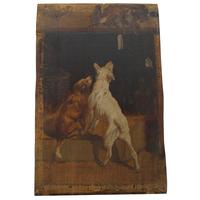
Dogs
William Henry Hamilton Trood
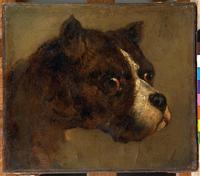
The head of bulldog
Théodore Géricault
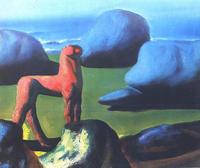
Vanity
Sabin Balasa
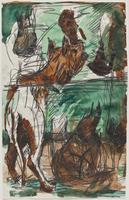
Dog-Split
Georg Baselitz
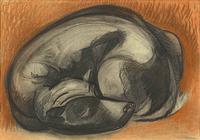
Sleeping Dog
Stanley Pinker
Dogs II
Carmen Delaco
"The Queen of Naples"
Maria Bozoky
Apollo's Chariot
Odilon Redon
Francisco Lezcano en su taller
Alberto Gironella
Untitled
Ligia Macovei
Dog
Francis Bacon
The man, the dog and the moon
Pedro Pont Vergés
dying dog
Toshihiko Okuya