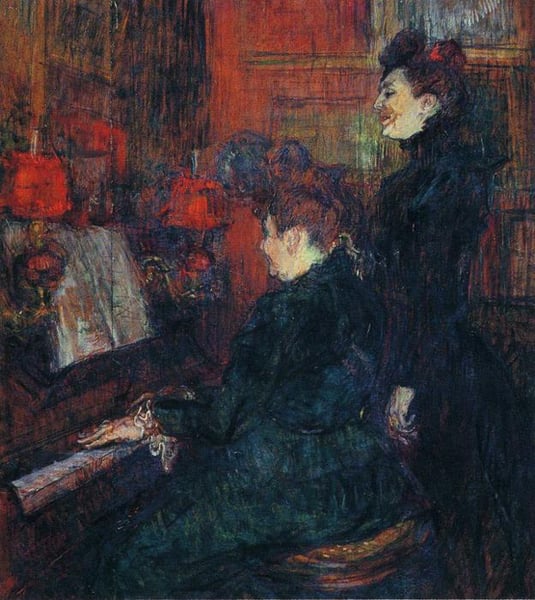
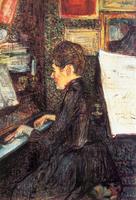
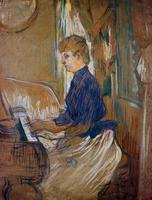
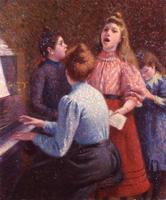
Henri de Toulouse-Lautrec’s The Singing Lesson (The Teacher, Mlle. Dihau, with Mme. Faveraud) is a compelling example of Post-Impressionist genre painting. Within the Post-Impressionist canon, the work is significant for its intimate, psychologically astute portrayal of an everyday moment—a private singing lesson—elevating the mundane to a subject worthy of serious artistic exploration. Toulouse-Lautrec eschews idealization in favor of candid observation, capturing the strained concentration of the pupil and the poised authority of the teacher. This reflects Post-Impressionism’s broader shift toward subjective expression and the artist’s personal vision, rather than objective reality. The composition’s off-center framing and flattened spatial cues, combined with the expressive use of contour and muted yet distinct color, underscore the artist’s debt to both Impressionist spontaneity and the more structured, emotional concerns of the Post-Impressionist movement. As a genre painting, it documents a private, gendered social ritual of the late 19th century, offering a window into the domestic lives of Parisian women—a theme Toulouse-Lautrec revisited often, though here with notable restraint compared to his cabaret scenes. The work’s significance lies in its ability to blend psychological depth with formal experimentation, hallmarks of Post-Impressionism that redefined how modern life could be rendered on canvas.