Expert analysis of Johannes Vermeer’s The Geographer
Style: Baroque · Genre: genre painting
Analysis of "The Geographer" by Johannes Vermeer
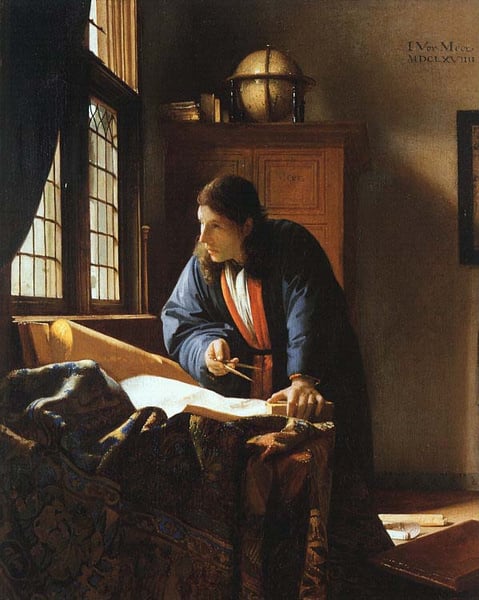
As a Baroque genre painting, Johannes Vermeer’s The Geographer stands out for its remarkable fusion of everyday domestic intimacy with the intellectual ambitions of the 17th-century Dutch Golden Age. While genre painting typically depicts scenes of common life, Vermeer elevates this subject by focusing on a solitary scholar at work, capturing a moment of quiet contemplation and scientific inquiry.
Significance within Baroque and Genre Painting:
-
Celebration of Knowledge: Baroque art often emphasized drama and grandeur, but Vermeer’s approach here is subtler: the geographer is not a heroic figure but a thinking man surrounded by maps, a globe, and a compass. This reflects the period’s growing value for empiricism, exploration, and cartography—themes that were transforming Europe’s worldview.
-
Masterful Use of Light and Space: Vermeer’s signature treatment of natural light pouring through a window aligns with Baroque interest in chiaroscuro and realism. Here, the light illuminates the geographer’s face and the folds of his robe, drawing the viewer’s eye to his focused expression and the precision of his tools. The composition, with the figure slightly off-center and the map as a backdrop, creates a sense of depth and quiet order.
-
Psychological Depth in Genre Scenes: Unlike many genre works that simply observe daily life, The Geographer offers a rare glimpse into a private moment of discovery. Vermeer invests the mundane act of studying a map with dignity and concentration, making the painting an early example of how genre painting could explore complex intellectual themes—a characteristic that would influence later art movements.
-
Symbolism of Transience and Human Ambition: The globe, the rolled map on the floor, and the book open to a double page allude to humanity’s desire to measure and understand the world. Yet the soft, almost misty light also hints at the fleeting nature of such pursuits, a Baroque memento mori embedded in a scene of intellectual confidence.
In essence, The Geographer is significant because it marries the Baroque fascination with dramatic light and realism to the genre tradition, elevating a scholar’s study into a timeless meditation on curiosity and the limits of human knowledge. Vermeer here proves that even the quietest moments can carry monumental meaning.
Museum / Gallery
Visually similar
20 works with related composition and palette
The astronomer
Johannes Vermeer
THE SCHOLAR AND HIS MAID IN AN INTERIOR
Hendrik Heerschop
Astronomer
Salomon Koninck
Man Writing a Letter
Gabriel Metsu
The Drawing Lesson
Jan Steen
The Payment of Dues
Georges de la Tour
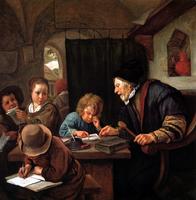
School teacher
Jan Steen
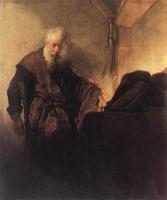
St. Paul at his Writing Desk
Rembrandt
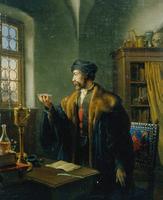
Faust on Easter Morning
Johann Peter Krafft
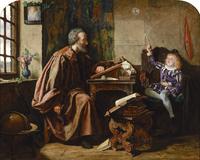
Sir Walter Raleigh in the Tower
Henry Wallis
An Old Scholar
Salomon Koninck
Alchemist in seiner Werkstatt
Thomas Wijck
Ritratto di Astronomo
Godfrey Kneller
Lawyer in His Study
Adriaen van Ostade
Artist in His Studio
Gerrit Dou
Merchant at a table near window
Abraham van Strij
A Man at his Desk
Salomon Koninck
Schoolmaster
Jan Steen
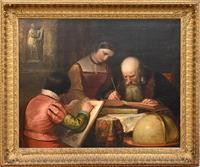
Scene
Daniel Huntington
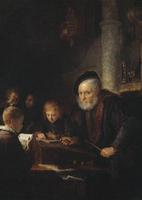
The Teacher
Gerrit Dou