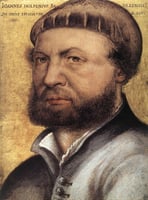
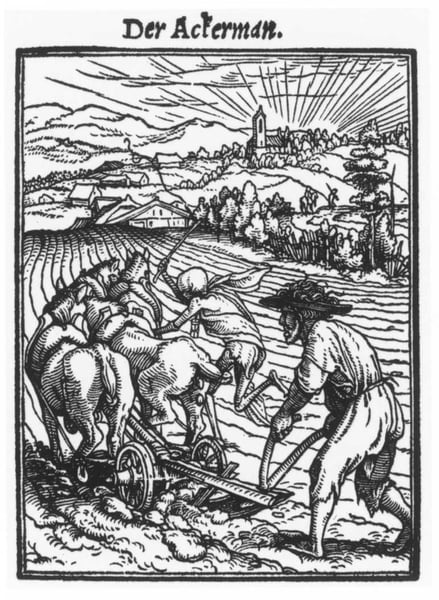
Expert analysis of Hans Holbein the Younger’s The Plowman
Style: Northern Renaissance · Genre: allegorical painting
Based solely on the provided facts, the significance of The Plowman by Hans Holbein the Younger lies in its masterful fusion of Northern Renaissance precision with allegorical depth.
As an allegorical painting from the Northern Renaissance style, the work transcends a simple depiction of rural labor. It uses the figure of the plowman not as a portrait, but as a symbolic vehicle for broader moral, religious, or social commentary—a hallmark of the period’s intellectual art.
This significance is rooted in two key aspects:
- Artistic Style: The Northern Renaissance emphasis on meticulous detail, naturalistic representation, and tactile textures gives the allegorical figure a grounded, convincing presence. The plowman is not an idealized classical figure but a specific, believable individual, making the abstract message (e.g., the dignity of labor, the inescapability of death, or the folly of worldly toil) more immediate and poignant.
- Genre & Message: By choosing an allegorical genre, Holbein uses the everyday act of plowing to speak about universal human conditions. The work likely engages with the era's profound preoccupations: mortality, religious faith, the social order, or the relationship between human effort and divine will. It is significant for how it elevates a common peasant task into a vehicle for philosophical reflection, a key contribution of Northern Renaissance artists to the history of ideas.
Thus, The Plowman is significant as a prime example of how Northern Renaissance artists combined acute observation of the real world with layered symbolism, creating works that are both visually rich and intellectually challenging.
Visually similar
20 works with related composition and palette
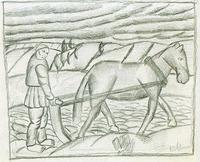
Plowman
Kazimir Malevich
Plowman with Two Women
Vincent van Gogh
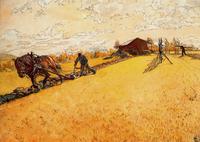
Plowing
Carl Larsson
At the Plough
Vincent van Gogh
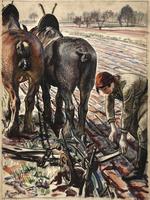
Horse-drawn plough, land girl
Laura Knight
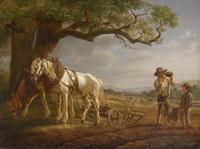
Peasants Resting in the Field
Albrecht Adam
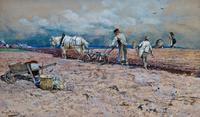
Peasants In The Field
Hugo Mühlig
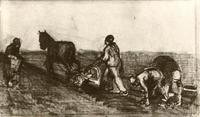
Ploughman and Three Women
Vincent van Gogh
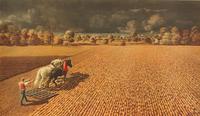
German Soil
Werner Peiner
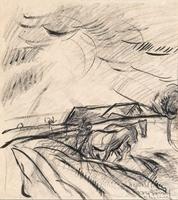
Egry József, Szántóvetők
Egry József
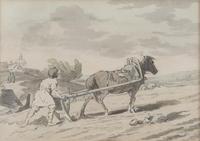
Scene
John Augustus Atkinson
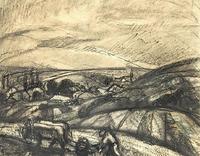
Egry József, Dombos Táj Szántóval
Egry József
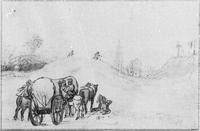
Roofoverval Op Een Wagen
Hendrick Avercamp
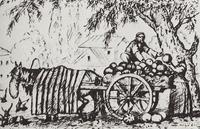
Tatar, who sells watermelons
Boris Kustodiev
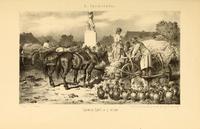
Genre scene
August von Pettenkofen
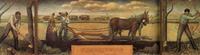
Breaking the Prairie
Grant Wood
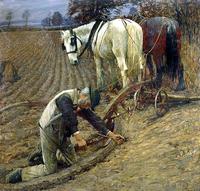
The Last Furrow
Henry Herbert La Thangue
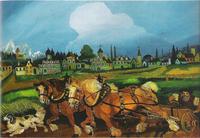
Planting with horses
Antonio Ligabue
Flock of sheep in a pasture
Theodore Rousseau
A Traveler in a Kibitka (Hooded Cart or Sledge)
Alexander Orlowski