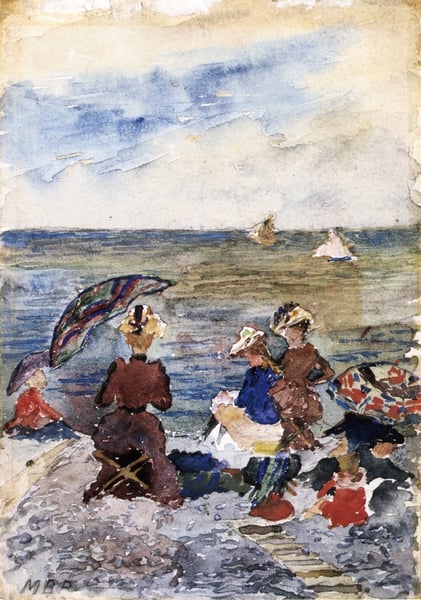
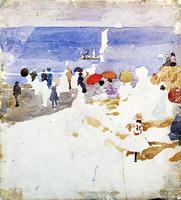
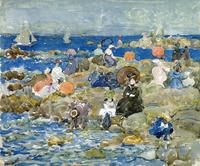
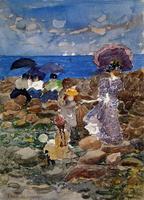
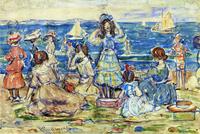
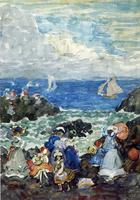
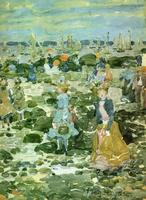
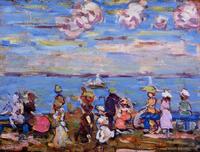
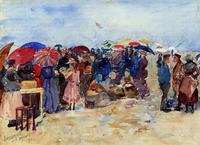
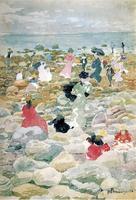
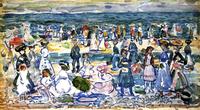
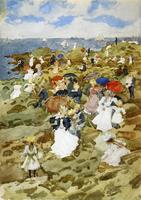
Maurice Prendergast’s Figures on the Beach exemplifies a distinctive American interpretation of Impressionism, merging the movement’s emphasis on light and atmosphere with a decorative, rhythmic composition. Although classified as a marina—a seascape with beach activity—Prendergast treats the scene not as a naturalist record but as a vibrant pattern of color and form. His use of short, dabbing brushstrokes and jewel-toned hues captures the shimmering summer light, while the flattened perspective and stylized, silhouette-like figures reveal an underlying concern for surface design and spatial tension. This work is significant for demonstrating how Prendergast pushed Impressionism beyond optical accuracy toward a more modern, patterned aesthetic, anticipating the decorative approaches of the Nabis and early modernist painting in the United States.