Black Iris
Analyse experte de Black Iris de Georgia O'Keeffe
Style : Precisionism · Genre : flower painting
Expert Analysis of "Black Iris" by Georgia O'Keeffe
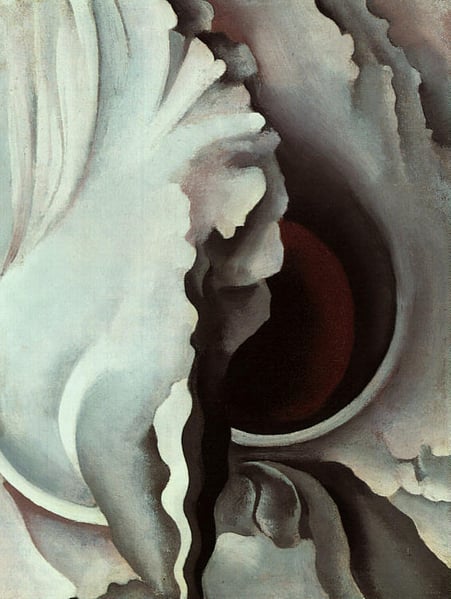
Georgia O’Keeffe’s Black Iris (1926) stands as a defining masterpiece of Precisionism, a movement that flourished in the United States between the World Wars. In this genre of flower painting, O’Keeffe radically reimagines botanical representation, pushing the natural world into the realm of near-abstraction while retaining the crisp, hard-edged clarity that defines Precisionist aesthetics.
Significance within Precisionism
Precisionism prized geometric order, smooth surfaces, and a cool, almost industrial detachment. O’Keeffe applies these principles to an organic subject. The iris is rendered with razor-sharp contours, its petals and sepals sculpted into sweeping, curvilinear planes that echo the streamlined forms of contemporary machinery. Yet, unlike the movement’s typical urban and industrial subjects—skyscrapers, factories, grain elevators—O’Keeffe turns to nature, demonstrating that Precisionism’s language could be used to magnify and abstract organic forms without losing their essence. The flower is isolated against a minimally defined background, forcing the viewer into an intimate confrontation with its monumental presence. This blending of the organic and the machined, the intimate and the monumental, is O’Keeffe’s singular contribution to the style.
Significance within the Flower Painting Genre
O’Keeffe transforms the traditional still life of floral beauty into a vehicle for psychological and sensory exploration. Black Iris is not a delicate, documentary study; it is a powerful, almost confrontational composition. The flower fills the canvas edge-to-edge, its deep, velvety black-purple center drawing the eye inward like a vortex. By magnifying the bloom to an enormous scale, O’Keeffe forces viewers to see it anew—to appreciate its intricate folds, its subtle gradations of color from deepest violet to shimmering gray, and its ambiguous, often sensuous forms. This ambiguity was deliberate: O’Keeffe famously resisted reductive readings of her flowers as mere symbols of female anatomy, insisting instead that they be seen as studies of shape, color, and the essential life force of nature.
Legacy
Black Iris exemplifies O’Keeffe’s ability to make the familiar strange and profound. It bridges the gap between representation and abstraction, between objective observation and emotional expression. In the context of Precisionism, it proves that the movement’s formal rigor could be applied with equal power to a single, close-up bloom as to a bird’s-eye view of Manhattan. For the genre of flower painting, O’Keeffe’s work broke free from tradition, asserting that a flower could be a subject of serious artistic inquiry—bold, dominant, and resonant with meaning beyond simple decoration.
Visuellement similaire
20 œuvres à la composition et à la palette proches
Dark Iris №3
Georgia O'Keeffe
Leaf Motif 2
Georgia O'Keeffe
Dark Iris №2
Georgia O'Keeffe
Dark Irises
Chiara Magni

Abstraction No. 77 (Tulip)
Georgia O'Keeffe

Iris 7
Georgia O'Keeffe
Flower of Life
Georgia O'Keeffe

As formas de Watu
Vannie Gama
Jack-in-the-Pulpit No. IV
Georgia O'Keeffe
Music Pink and Blue
Georgia O'Keeffe
Flower Abstraction
Georgia O'Keeffe
Black Irises
Max Beckmann
Iris in a vase 1886
Marie Bracquemond

Nature Forms Gasp
Georgia O'Keeffe
Black Place Green
Georgia O'Keeffe
Black Iris III
Georgia O'Keeffe
Irises
Martiros Sarian
Flower of Life II
Georgia O'Keeffe
Based on Leaf Forms and Spaces
Arthur Dove
Hybrizidation
Nassos Daphnis