Analisi esperta di Ib di Lucian Freud
Stile: Expressionism · Genere: portrait
Artwork: Ib by Lucian Freud
Style: Expressionism
Genre: Portrait
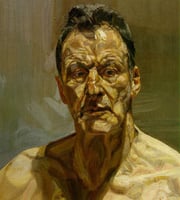
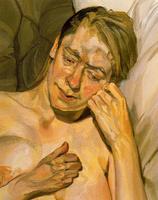
Lucian Freud’s Ib stands as a quintessential example of late 20th‑century Expressionist portraiture, where psychological intensity and physical presence converge. Unlike the idealized or heroic portraits of earlier eras, Freud’s approach is unflinchingly direct: he strips away artifice to reveal the raw, vulnerable humanity of his sitter.
Stylistic Significance
Freud’s Expressionism is not about dramatic color or exaggerated emotion in the manner of early German Expressionists; instead, it is rooted in a visceral, almost sculptural handling of paint. The thick, impasto brushstrokes in Ib build up the flesh, making the skin appear dense, heavy, and palpably alive. This technique—layering and scraping pigments until the surface becomes a landscape of its own—gives the portrait a tactile immediacy that forces the viewer to confront the sitter’s corporeality. Every wrinkle, sag, or blemish is rendered with clinical yet empathetic precision.
Genre and Psychological Depth
As a portrait, Ib defies conventional flattery. Freud often painted friends, family, or artists’ models (such as the famous “Ib”—likely a nickname for a recurring model, possibly the performance artist Leigh Bowery or the writer/editor Ibby Njoya, though the exact identity is not provided). The sitter’s gaze is often confrontational or vulnerable, never passive. In Expressionist tradition, the external appearance becomes a window to the inner self—here, that inner self is fraught, opaque, and deeply human. The composition is typically close-up, with the sitter filling the frame, eliminating context or distraction. This forces an uncomfortable intimacy, as if the viewer is invading a private moment.
Place within Freud’s Oeuvre
Freud’s work bridges the figurative tradition of painters like Rembrandt and Ingres with modern existential anxiety. Ib exemplifies his late mature period, where muted earth tones (ochres, greys, greens) dominate, and the lighting is stark, almost clinical. The significance lies in how Freud uses Expressionist distortion—subtle elongation of features, asymmetrical eyes, or a slightly off-kilter composition—to destabilize our perception, making the familiar strange. The portrait becomes a psychological study of being itself: flawed, fleeting, and unfiltered.
In sum, Ib is significant because it pushes Expressionist portraiture beyond mere emotional expression into a profound investigation of physical and psychological truth, cementing Freud’s reputation as one of the most uncompromising figurative painters of the modern era.
Museum / Gallery
Visivamente simili
20 opere con composizione e palette affini
Frances Costelloe
Lucian Freud
Sleeping Head
Lucian Freud
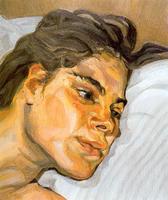
Esther
Lucian Freud
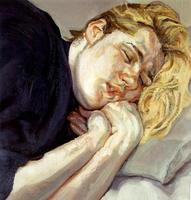
Susie
Lucian Freud
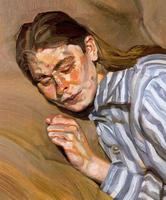
Girl in Striped Nightshirt
Lucian Freud
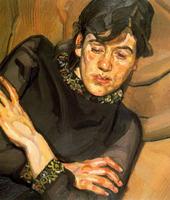
Bella
Lucian Freud
Girl with Fair Hair
Lucian Freud
Alvó Lány
Bela Czobel
Cabeza
Raquel Forner
Creole Girl
Matthew Smith
Czóbel Béla Könyöklő Lány
Bela Czobel
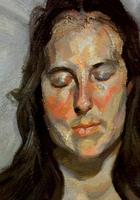
Woman with Eyes Closed
Lucian Freud
Annie
Lucian Freud
Girl in Bed
Lucian Freud
Sleeping Katya
Zinaida Serebriakova
Liegende
Otto Mueller
Portrait of Dorrit Black
Jacqueline Hick
Scheiber Hugó, Fekvő Nő 1912
Scheiber Hugó
Schizophrenia
Sami Gattoufi
Girl with closed eyes
Lucian Freud