Lucian Freud sanatçısının The Painter's Mother Resting III eseri hakkında uzman analizi
Tarz: Expressionism · Tür: portrait
Expert Analysis of "The Painter's Mother Resting III" by Lucian Freud
Within the context of Expressionism, Lucian Freud’s The Painter’s Mother Resting III stands as a profound exploration of intimacy, mortality, and the unvarnished human condition. Although Freud is often associated with a distinctive brand of figurative realism, this portrait—painted late in his career—exemplifies the core Expressionist impulse to convey raw emotional truth over idealized representation.
Significance within the Style and Period
-
Emotional Rawness and Psychological Depth
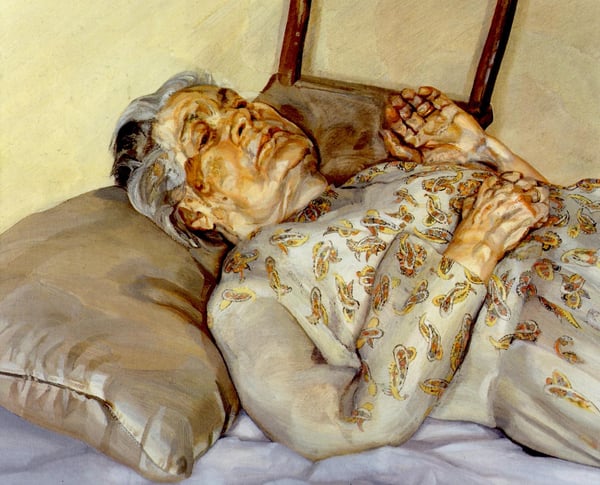
Expressionism prioritizes the artist’s subjective experience, and Freud achieves this through his unflinching depiction of his elderly mother at rest. The painting does not flatter or sentimentalize; instead, it captures vulnerability, fatigue, and the quiet dignity of aging. The subject’s closed eyes and relaxed pose suggest a private moment, inviting the viewer into an intimate psychological space—a hallmark of Freud’s Expressionist approach. -
Brushwork and Materiality
Freud’s thick, impasto brushstrokes are a signature of his mature style, lending the canvas a tactile, almost sculptural quality. In this work, the heavy application of paint around the face and hands heightens the sense of physical presence while also distorting form slightly—an Expressionist device that prioritizes feeling over photographic accuracy. The muted, earthy palette (browns, grays, pale flesh tones) reinforces a mood of somber introspection. -
Context of the Series
This painting is the third in a series of portraits of Freud’s mother, each exploring her declining health and his own complex relationship with her. By repeatedly returning to this subject, Freud aligns with the Expressionist tradition of using art as a means of processing personal grief, love, and loss. The work’s significance lies not only in its technical mastery but in its unsparing honesty—a willingness to confront the fragility of life without resorting to sentimentality. -
Influence on Portraiture
While earlier Expressionists like Egon Schiele or Edvard Munch often used distorted line and color for dramatic effect, Freud’s version of Expressionism relies on psychological intensity achieved through meticulous observation and painterly texture. The Painter’s Mother Resting III thus bridges the gap between traditional portraiture and modern Expressionist inquiry, proving that the genre can still resonate powerfully by focusing on the sitter’s inner world.
In summary, this painting is significant because it exemplifies how Expressionism can be channeled through hyper-observant realism to produce a deeply moving, emotionally charged portrait. It cements Freud’s reputation as a master of psychological depth, and within his own oeuvre it stands as a poignant testament to the artist’s lifelong exploration of human frailty and connection.
Museum / Gallery
Görsel olarak benzer
İlişkili kompozisyon ve renk paletine sahip 20 eser
The Painter's Mother Resting I
Lucian Freud
The Painter's Mother
Lucian Freud
Second Visit
Luis Álvarez Roure
The Painter's Mother
Lucian Freud
Last Visit
Luis Álvarez Roure
Large Interior, London W.9.
Lucian Freud
Mrs Green
Richard Eurich
Valentine Gode Darel in hospital bed
Ferdinand Hodler
Gitane Endormie (sleepy Gypsy)
Robert Falk
Fallen Russian Soldier
Laszlo Mednyanszky
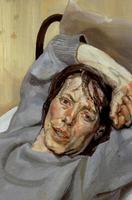
Woman in a Grey Sweater
Lucian Freud
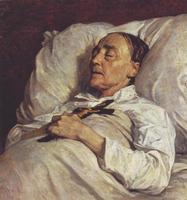
Portrait of Madame Mazois on her Deathbed
Henri Regnault
Peaceful Sleep
Corneliu Baba
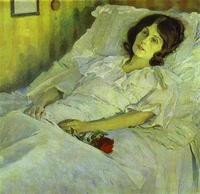
A Sick Girl
Mikhail Nesterov
In Switzerland
John Singer Sargent
Reclining on the bed
Marc Chagall
Girl with closed eyes
Lucian Freud
Peter Harrison Asleep
John Singer Sargent
Alice Runnels James (Mrs. William James)
John Singer Sargent
Lavinya on the sofa
Mariam Aslamazian