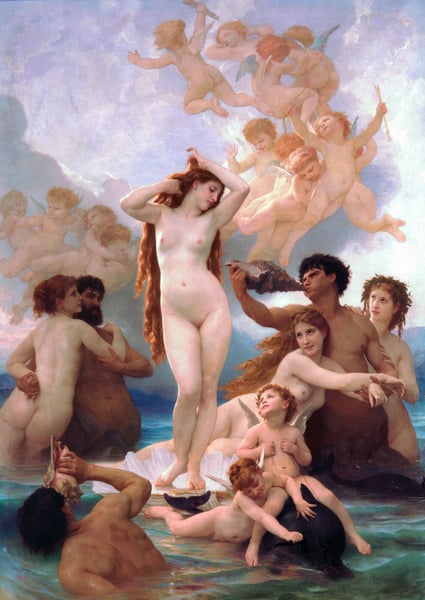
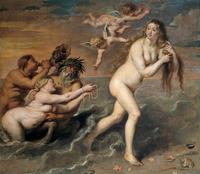
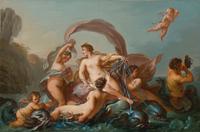
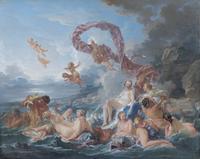
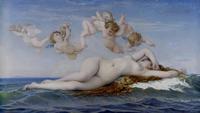
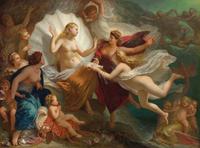
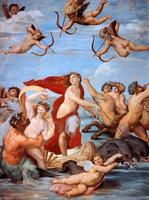
Bouguereau's rendition of a well-known Roman mythology tale portrays Venus, the goddess of love and beauty, emerging from the sea on a shell, surrounded by a group of nymphs, tritons, and putti who admire her. The goddess assumes the classic contrapposto stance of Venus Anadyomene, accentuating the curves of her body while adjusting her hair. The painting's cool pastel hues create an atmosphere that evokes the dewy world of the sea.
Bouguereau drew inspiration from Renaissance masterworks like Raphael's The Triumph of Galatea and Botticelli's Birth of Venus, which he studied during his Prix de Rome scholarship in Italy. Unlike Raphael and Botticelli's nudes, Bouguereau's Venus displays a refined naturalism that reflects the new artistic tastes of the 1870s while retaining a Neoclassical artifice. The painting satisfies the challenge set by T.J. Clark for late-19th-century Salon painters to depict the flesh of modern women in Naturalist style while adhering to the Academic ideal of "the body as a sign, formal and generalized, meant for a token of composure and fulfillment." Although Bouguereau's Venus is technically perfect and realistic, she lacks individual identity and remains confined to the role of an ideal.
Bouguereau's Venus received much acclaim and proved to be a commercial success. The painting's strong eroticism hints at Bouguereau's pragmatic methods of appealing to buyers. Unlike Botticelli's Venus, who hides her bosom seductively, Bouguereau's Venus invites the viewer to examine every part of her, unashamed of her nakedness and sensuality.