
Expertenanalyse zu Paolo Veroneses Prudence and Manly Virtue
Stil: Mannerism (Late Renaissance) · Genre: allegorical painting, trompe-l'œil
Expert Analysis of "Prudence and Manly Virtue" by Paolo Veronese
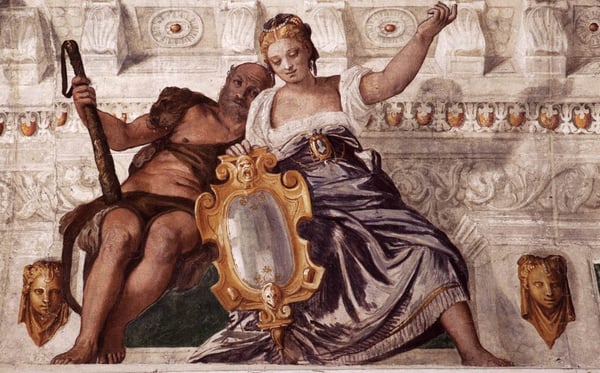
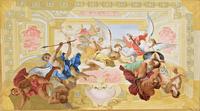
Paolo Veronese’s Prudence and Manly Virtue exemplifies the Mannerist penchant for intellectual allegory fused with dazzling illusionistic technique. Painted in the late Renaissance, the work demonstrates how Venetian colorito and bravura brushwork could elevate moral themes into a visually captivating spectacle.
Significance within Mannerism and the Late Renaissance
-
Allegorical Personification: The painting represents two virtues—Prudence (often depicted with a mirror or serpent, signifying foresight and wisdom) and Manly Virtue (typically symbolized by strength, fortitude, or heroic resolve). Veronese here follows the Mannerist taste for complex, learned iconography that demands interpretation, moving beyond straightforward religious narratives to engage the viewer’s intellect.
-
Trompe-l'œil Mastery: The use of trompe-l'œil—an illusionistic device meant to trick the eye—places the virtues in a fictional architectural or sculptural setting, blurring the boundary between painted space and reality. This technique was especially prized by Mannerist artists for its demonstration of technical virtuosity and its ability to create a playful, self-aware dialogue with the audience. Veronese’s handling of light and shadow, coupled with precise foreshortening, gives the figures a tangible, almost three-dimensional presence.
-
Stylistic Traits of Mannerism: The elongated proportions of the figures, their theatrical poses, and the artificial, mannered elegance of their drapery reflect the Mannerist departure from High Renaissance naturalism. Veronese, while rooted in the Venetian tradition of rich color and sumptuous texture, here adopts a more consciously refined, intellectualized form—one that prioritizes grace, complexity, and visual surprise over simple harmony.
Why It Matters
Prudence and Manly Virtue stands as a prime example of how late Renaissance artists combined moral instruction with sophisticated pictorial illusion. Veronese’s ability to render precious fabrics, marble-like flesh, and atmospheric depth within a single allegorical frame underscores his reputation as a master of decorative and narrative grandeur. The work’s significance lies in its seamless synthesis of didactic content (the virtues as guides to noble conduct) with the Mannerist delight in artifice—a reminder that in the hands of a genius, even a lesson in virtue could become a breathtaking exercise in optical wit.
Visuell ähnlich
20 Werke mit ähnlicher Komposition und Farbpalette
Saturn (Time) and Historia
Paolo Veronese
Chance Crowning a Sleeping Man
Paolo Veronese
Nemesis
Paolo Veronese
Mortal Man Guided to Divine Eternity
Paolo Veronese
Minerva between the Geometry and Arithmetic
Paolo Veronese
Ignudo
Michelangelo
Bacchus and Ceres
Paolo Veronese
Strength, Vigilance and Prudence
Alessandro Allori
Ignudo
Michelangelo
Glory
Alessandro Allori
Fortune
Paolo Veronese
Muse with Lyre
Paolo Veronese
Magnanimity, Magnificence and Liberality
Alessandro Allori
Ignudo
Michelangelo
Ignudo
Michelangelo
Diana
Correggio
Hyman, Juno and Venus
Paolo Veronese
Bacchus, Vertumnus and Saturn
Paolo Veronese
Annunciation
Francesco de' Rossi (Francesco Salviati), "Cecchino"
Engelssturz
Johann Peter Krafft