Paragons of Filial Piety
Analisi esperta di Paragons of Filial Piety di Utagawa Kuniyoshi
Stile: Ukiyo-e · Genere: genre painting
Expert Analysis: "Paragons of Filial Piety" by Utagawa Kuniyoshi
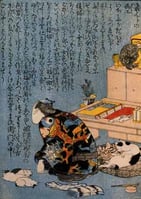
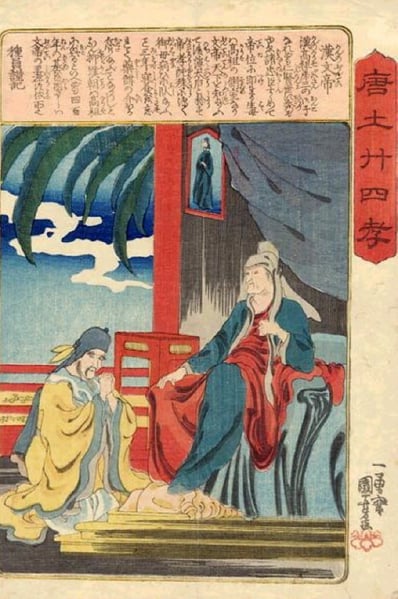
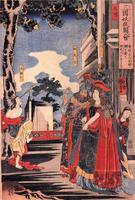
This work, a genre painting executed in the ukiyo-e style, demonstrates Utagawa Kuniyoshi’s mastery of narrative moral instruction within the popular print tradition. While ukiyo-e is often associated with fleeting pleasures—courtesans, kabuki actors, and landscapes—Kuniyoshi here elevates the form by engaging with Confucian virtue ethics, specifically the theme of filial piety (kō). This choice marks a significant intersection between mass-market woodblock prints and classical Chinese moral philosophy, a fusion that appealed to Edo-period audiences seeking both entertainment and ethical edification.
Stylistic and Compositional Significance:
Kuniyoshi, famed for his dynamic warrior prints and the 108 Heroes of the Suikoden series, applies a similar compositional vigor to this more serene subject. The figures are arranged in clear, balanced groups, each illustrating a different act of devotion. His use of bold outlines, flat yet modulated color fields, and close attention to textile patterns are hallmarks of mature ukiyo-e. However, unlike his action-packed battle scenes, the drama here is internal—expressed through expressive postures, careful hand gestures, and the subtle interplay of gazes. This demonstrates Kuniyoshi’s versatility: he could render both violent spectacle and quiet virtue with equal visual intelligence.
Cultural and Historical Context:
During the late Edo period, the Tokugawa shogunate promoted Neo-Confucianism as a state ideology to reinforce social hierarchy and familial loyalty. Paragons of Filial Piety directly serves this moral agenda, yet Kuniyoshi’s treatment is not didactic or stiff. He humanizes the paragons, embedding them in recognizable domestic settings—a kitchen, a garden, a sickroom—that ground abstract ethics in the everyday experience of his viewers. This reflects ukiyo-e’s core function as a mirror of contemporary life, even when the subject is lifted from ancient Chinese texts such as the Twenty-four Filial Exemplars.
Technical Achievement and Legacy:
Kuniyoshi and his contemporaries, including Hiroshige and Hokusai, pushed ukiyo-e beyond mere illustration into sophisticated visual storytelling. The careful use of bokashi (color gradation) in the sky and landscape elements, combined with crisp outlines from key-block impressions, shows the high technical standard of the Utagawa school workshop. Moreover, by choosing a genre painting of moral paragons rather than a famous beauty or warrior, Kuniyoshi broadened ukiyo-e’s thematic scope, proving that even the most conventional Confucian lessons could be rendered with artistic flair and popular appeal. This work stands as a testament to how ukiyo-e artists synthesized foreign ideology with native aesthetic traditions, creating a uniquely Japanese form of moral art that remains visually compelling today.
Visivamente simili
20 opere con composizione e palette affini
Kôteiken
Utagawa Kuniyoshi
Young Emperor
Utagawa Kuniyoshi
圣贤事迹2
Qian Xuan
Immortals Celebrating a Birthday
Chen Hongshou
Ni Zan's portrait
Qiu Ying
Tsuchiyama
Utagawa Kuniyoshi
The Salt Dragon
Toyota Hokkei
The Famous Unrivalled Hidari Jingoro
Utagawa Kuniyoshi
Neve, the moon is chilling
Utagawa Kuniyoshi
The Ghost Triptych
Tsukioka Yoshitoshi
Nihon hana zue
Ogata Gekko
挥扇仕女图
Qian Xuan
圣贤事迹1
Qian Xuan
Dipicting the characters from the Chushingura
Utagawa Kuniyoshi
Street scenes newly pubished
Katsushika Hokusai
A scene of Journey to the West
Tsukioka Yoshitoshi
Dipicting the characters from the Chushingura
Utagawa Kuniyoshi
倣唐人仕女圖
Tang Yin
Lady Kayo
Utagawa Kuniyoshi
Ichikawa Monnosuke II, Matsumoto Kōshirō IV, and Iwai Hanshirō IV
Tōshūsai Sharaku