Analisi esperta di A maiden, a widow and a wife di Max Ernst
Stile: Surrealism · Genere: symbolic painting
Analysis of "A maiden, a widow and a wife" by Max Ernst
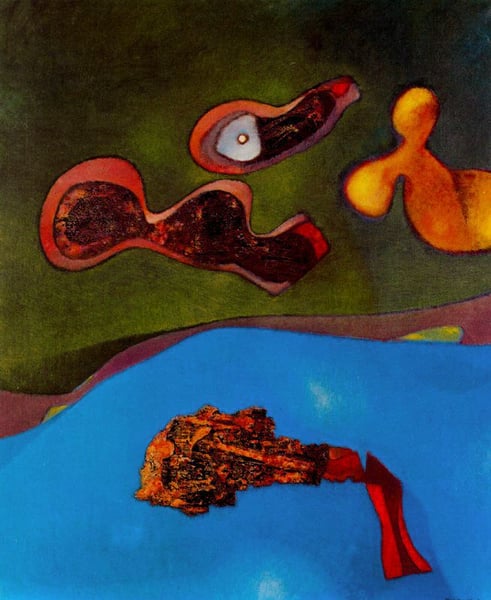
Max Ernst’s A maiden, a widow and a wife, executed during his Second French period (c. late 1930s – early 1940s), exemplifies the core Surrealist project: the disruption of rational order through symbolic, dreamlike imagery. As a symbolic painting, the work moves beyond literal representation to explore the psychological and mythical dimensions of female identity.
Significance within Surrealism:
- Archetypal transformation: The title presents three conventional female life stages (maiden, widow, wife). Ernst subverts these roles by juxtaposing them in a single composition—likely depicting a fluid, metamorphic figure rather than three distinct portraits. This reflects Surrealism’s interest in the unconscious, where boundaries of time, maturity, and social roles collapse.
- Collage-like logic: Even in painting, Ernst’s characteristic collage aesthetic persists. The “second French period” marks his mature integration of frottage, grattage, and decalcomania with precise symbolic detail. The work likely combines organic textures with sharp, incongruous elements (e.g., a bird-like head, architectural fragments) to suggest the coexistence of innocence, loss, and domesticity.
- Psychic automatism vs. control: Ernst balances automatic mark-making (to access the irrational) with deliberate, unsettling symbolism. The painting’s significance lies in this tension: the viewer is drawn into a coherent composition that defies logical narrative, inviting a free-associative reading of femininity as a mythic, mutable force.
Relevance to the Second French Period:
- Exile and mythologizing: Ernst fled Nazi Germany and settled in France during this period. The work can be seen as a response to displacement—exploring archetypal roles as both personal and universal, providing a framework for identity under threat.
- Precursor to postwar surrealism: This painting bridges early Surrealist experiments (Man Ray, Miró) and the later, more narrative symbolism of artists like Leonora Carrington. Its layered treatment of female archetypes anticipates feminist reinterpretations of Surrealist imagery in the decades to come.
In sum, A maiden, a widow and a wife is significant for its dense, symbolic compression of time and identity, executed with the technical inventiveness that defines Ernst’s most compelling Surrealist work.
Museum / Gallery
Visivamente simili
20 opere con composizione e palette affini
Landscape with Wheatgerm
Max Ernst
Mask 4
Willi Baumeister
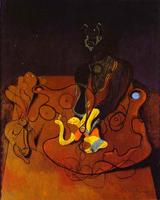
A Night of Love
Max Ernst
Painting on light ground
Wassily Kandinsky
Manantial
Esteban Frances
Mid Summers End
Justin Earl Grant
O banho turco
Julio Pomar
The Betrothal II
Arshile Gorky
Figures in Front of a Metamorphosis
Joan Miro
Stone Garden
Willi Baumeister
The Observer
Arshile Gorky
La sarabande de l'eté
Corneille
Soft Night
Arshile Gorky
Untitled
Maurice Esteve
Urbana #4
Richard Diebenkorn
My Grandmother's Lorgnette
Endre Rozsda
Still Life with Lamp
Joan Miro
Lines
Rudolf Bauer
On the Islands with You
George Saru
Two Lovers
Carloluigi Colombo