Analisi esperta di Garden Airplane Trap di Max Ernst
Stile: Surrealism · Genere: symbolic painting
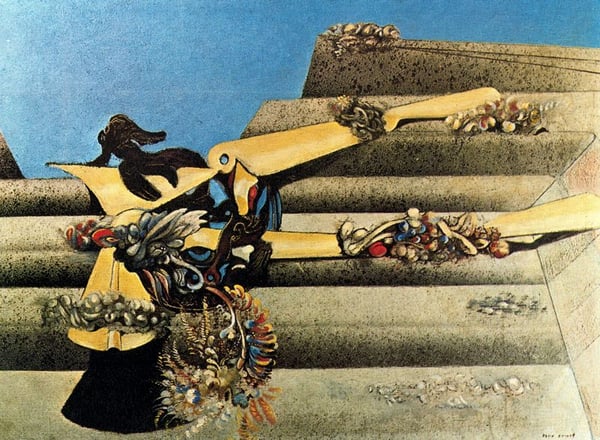
"Garden Airplane Trap" by Max Ernst (c. 1935–36, First French period)
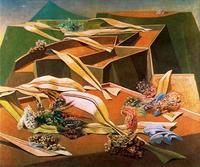
This painting exemplifies the core Surrealist strategy of dislocation—the jarring, dreamlike collision of organic and mechanical worlds. Ernst transforms a lush garden into a menacing, irrational space by inserting airplane forms that act as both insect-like invaders and static traps. The composition blurs the boundary between living vegetation and metallic object, creating a hybrid landscape that feels at once fertile and hostile.
Significance within Surrealism and Ernst’s oeuvre:
- It belongs to Ernst’s First French period (1922–1938), when he refined his signature techniques of frottage and grattage (rubbing and scraping paint) to produce textured, hallucinatory surfaces. Here, the grainy, rubbed-in patches evoke moss, soil, or corroded metal, reinforcing the organic-mechanical confusion.
- The painting embodies the Surrealist fascination with the unconscious and the irrational. The “airplane trap” suggests a paranoid, premonitory vision of aerial warfare—predating the Spanish Civil War and WWII—yet it is rendered as a static, ritualistic object embedded in nature, as if from a dream where machines take on botanical life.
- As a symbolic painting, the work rejects narrative logic in favor of a dense web of associations: the garden as Edenic innocence and as death trap; the airplane as modern progress and as predatory insect. This ambiguity—beauty tinged with menace—is a hallmark of Ernst’s most powerful Surrealist imagery.
Art-historical importance:
"Garden Airplane Trap" demonstrates how Surrealism moved beyond simple hallucinatory pictures to create complete alternate realities. Ernst’s blending of biomorphic and technological forms anticipates later movements like biomorphism and even aspects of post-war science fiction aesthetics. The work remains a key example of how Surrealist painting turned the everyday world into a site of uncanny revelation.
Visivamente simili
20 opere con composizione e palette affini
The Lugubrious Game
Salvador Dali
Large Painting Representing a Landscape
Yves Tanguy
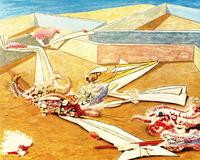
Flying Horse Garden
Max Ernst
Composición surrealista
Esteban Frances
Playing in the Dark
Salvador Dali
Garden Airplane Trap
Max Ernst
Escape
Nina Tokhtaman Valetova
Study for "Honey is Sweeter than Blood"
Salvador Dali
Untitled
Enrique Silvestre
Man and Woman
Fernand Leger
The Rotting Donkey
Salvador Dali
Persistence of Fair Weather
Salvador Dali
Thorn Tree
Graham Sutherland
Three characters
Fernand Leger
Je les ai deviné trop souvent au fond de l'eau
Theo Gerber
The Red Guard
Desmond Morris
Cadavre Exquis (Surrealist Group Collective Work)
Marcelino Vespeira
The Tilled Field
Joan Miro
The Twilight
Nina Tokhtaman Valetova
A World
Ángeles Santos Torroella