Deskundige analyse van The Robing of the Bride van Max Ernst
Stijl: Surrealism · Genre: symbolic painting
Expert Analysis of The Robing of the Bride (1940) by Max Ernst
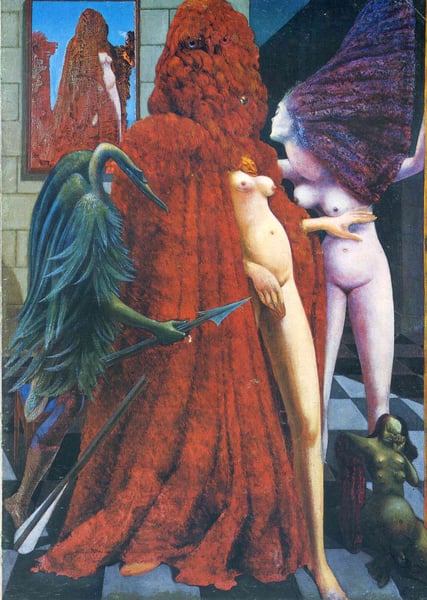
As a quintessential work of Surrealism from Max Ernst’s First French period, The Robing of the Bride stands as a landmark of symbolic painting, embodying the movement’s fascination with the irrational, the dreamlike, and the psychological depths of human desire. Painted in the midst of Ernst’s most fertile creative years in France—before his forced exile due to war—the work synthesizes his signature techniques of frottage and decalcomania with a meticulously rendered, almost theatrical composition.
Significance within Surrealism and Symbolic Painting
-
Subversion of Tradition
The title itself is a darkly ironic twist on the conventional theme of bridal preparation, a subject long associated with purity and joy in Western art. Ernst transforms the ritual into a hallucinatory, unsettling scene: the bride, a spectral figure with a bird-like head and a flowing gown, is “robed” not by loving attendants but by a strange, mechanical creature—a grotesque hybrid of armor and organic forms. This inversion aligns with Surrealism’s goal of destabilizing societal norms, especially those surrounding gender, marriage, and the sacred. -
Symbolic Imagery and the Unconscious
Every element in the painting functions as a symbol drawn from Ernst’s personal mythology and Freudian concepts. The bird-headed bride recalls the artist’s alter ego, Loplop (the “Bird Superior”), a recurring motif in his work that represents the unconscious mind and the creative impulse. The robe itself—a shimmering, textured mass created via decalcomania, where paint is pressed and scraped to mimic organic forms—suggests both a veil and a shroud, merging eroticism with decay. The male figure on the left, half-human and half-mechanical, evokes the repressed drives of the psyche, while the distant landscape and skeletal architectural details hint at a post-apocalyptic or liminal space. -
Technical Innovation and Period Context
During his First French period (1922–1941), Ernst pushed Surrealist technique into new territory, combining automatic processes with meticulous craftsmanship. The Robing of the Bride exemplifies this synthesis: the background’s granular, landscape-like surface results from frottage (rubbing graphite over textured surfaces), while the central figures are painted with crisp, academic precision. This contrast between chaos and control mirrors the Surrealist aim of reconciling dream and reality. The work also reflects the anxieties of the late 1930s—the rise of fascism, the looming war—transfigured into a personal, symbolic drama.
Lasting Impact
As a symbolic painting, The Robing of the Bride is pivotal for its ability to weave together myth, autobiography, and social critique into a single, enigmatic image. It remains a powerful testament to Surrealism’s capacity to challenge perception, using the visual language of dreams to reveal the unsettling truths buried beneath civilization’s rituals.
Museum / Gallery
Visueel vergelijkbaar
20 werken met verwante compositie en kleurenpalet
The Spanish Physician
Max Ernst
The Antipope
Max Ernst
Wizard Woman
Max Ernst
Metamorphoses of Lucretia
Ernst Fuchs
Dryads
Paul Delvaux
Procession
Frantisek Kupka
Three Wenches
Otto Dix
THE WEDDING OF THE UNICHORN
Ernst Fuchs
HUNTING THE GOLDEN HEART
Ernst Fuchs
L’Entracte de l’Apothéose
Leonor Fini
Roger delivering Angelica
Felix Vallotton
Benediction
Carlos Schwabe
La Femme à L'Ara
Jean Dupas
Battle of the gods that have been transformed
Ernst Fuchs
Les Paons
Raphael Delorme
Serenata Açoriana
Antonio Dacosta
Vanity
Aladar Korosfoi-Kriesch
The Bleeding Roses
Salvador Dali
The Sleeping Town
Paul Delvaux
THE LOST ORDEAL
Ernst Fuchs