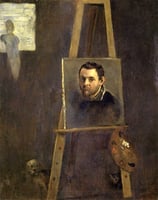
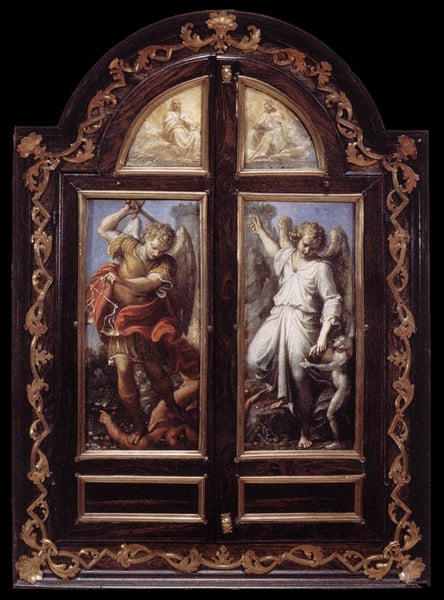
Analisi esperta di Triptych di Annibale Carracci
Stile: Baroque · Genere: religious painting
Expert Analysis: "Triptych" by Annibale Carracci
As a pivotal figure in the transition from Mannerism to the Baroque, Annibale Carracci invested religious painting with a renewed naturalism and emotional clarity that would define the Baroque era. While the specific subject of this triptych is not detailed, the very format—a three-panel altarpiece—was traditionally used to structure narratives around a central sacred event, often flanked by saints or donors. Carracci’s treatment of such a format would be significant for its rejection of the artificial elongation and complex allegory of Late Mannerism in favor of a grounded, humanized spirituality rooted in the study of nature and classical antiquity.
Significance within the Baroque:
- Synthesis of Naturalism and Monumentality: Carracci’s approach, often called “Baroque Classicism,” blends the idealized forms of Raphael with the earthy, direct observation of the human figure. In a triptych, this would manifest in solid, anatomically credible figures placed in convincingly atmospheric space, using strong chiaroscuro to create dramatic depth—hallmarks of early Baroque religious narrative.
- Emotional Engagement: Unlike the remote elegance of Mannerist religious works, Carracci aimed to make the sacred feel accessible. His figures display legible, heartfelt emotion through gesture and facial expression, drawing the viewer into empathetic contemplation of the divine mystery portrayed.
- Unified Composition: Even across three panels, Carracci would have unified the triptych through consistent lighting, a shared horizon line (if landscape is present), and color harmonies. This coherence was an innovation over earlier polyptychs, aligning with the Baroque desire for a unified, theatrical experience.
Historical Importance: Carracci’s altarpieces, such as the renowned Domine, Quo Vadis? or the Pietà, set the standard for 17th-century church art. This triptych, likely executed for a chapel at a critical moment in the Counter-Reformation, would demonstrate how art could teach, move, and inspire faith through natural beauty and clear storytelling—a legacy that influenced Bolognese painters like Domenichino and later the great Baroque masters. Its significance lies in its balance: a controlled, classicist structure animated by Baroque energy, making the divine intimately real.
Museum / Gallery
Visivamente simili
20 opere con composizione e palette affini
The Resurrection of Christ
Peter Paul Rubens
Madonna dell'Orto (Venice) - Chapel Morosini - Angels carrying the censer (right)
Domenico Tintoretto
Annunciation
Maerten van Heemskerck
Altar of Archangel Michael
Gerard David
Archangel Michael
Álvaro Pires de Évora
Saint Michel terrassant le démon
Charles Meynier
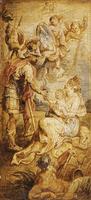
The Birth of Henri IV of France
Peter Paul Rubens
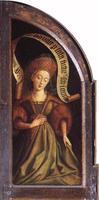
The Cumaean Sibyl
Jan van Eyck
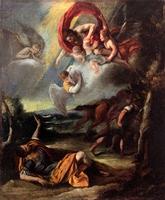
Obra Preparatòria De La Conversión De San Pablo
Juan Bautista Maíno
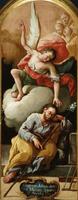
Dream of Joseph
José Luzán
Demócrito Con Diógenes
Salvator Rosa
Christus am Ölberg
Heinrich Schonfeld
Apotheosis of St Joseph
Bartolomeo Altomonte
Archangel Michael
Ivan Rutkovych
The Angel of the Annunciation
Gerard David
St. Jerome
Lorenzo Lotto
The Altarpiece of the Holy Cross
Adam Elsheimer
The miracle of two saints
Luis González Velázquez
Abraham and the three angels
Jean II Restout
Archangel Michael
Vladimir Borovikovsky