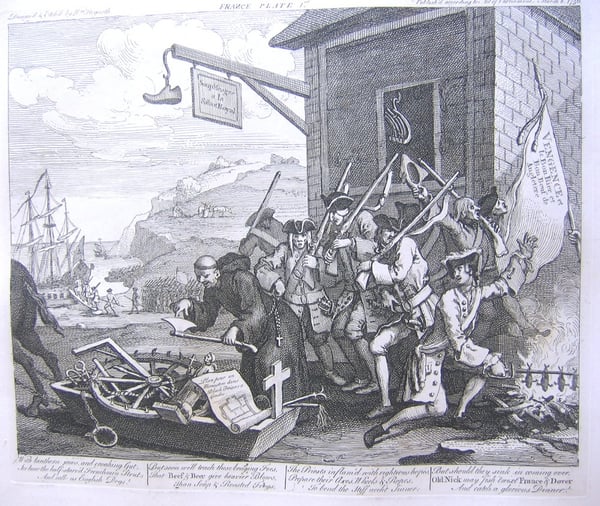
The Invasion, France
Подробности
Экспертный разбор работы «The Invasion, France» художника William Hogarth
Стиль: Rococo · Жанр: allegorical painting
Expert Analysis: "The Invasion, France" by William Hogarth
William Hogarth’s “The Invasion, France” (c. 1756) is a masterful example of how the Rococo style—often associated with aristocratic frivolity and delicate ornament—could be repurposed for sharp political satire. Painted as an allegorical companion to “The Invasion, England,” this work employs Rococo’s characteristic fluid lines, asymmetrical compositions, and decorative detailing to mock French military ambition during the Seven Years’ War, while simultaneously serving as a piece of patriotic propaganda.
Significance within Rococo and Allegorical Painting
-
Subversion of Rococo Conventions:
Typical Rococo painting (e.g., by Watteau or Boucher) celebrates leisure, eroticism, and pastoral fantasy. Hogarth twists these very qualities into a grotesque parody. The French soldiers are rendered with exaggerated, almost doll-like features; their uniforms are bedecked with ornate flourishes that echo Rococo’s love of curving drapery, yet here those details become emblems of effete decadence. The softened palette and delicate brushwork—hallmarks of Rococo—are used to depict a chaotic scene of preparation for invasion, contrasting the elegance of the style with the brutality of the subject. -
Allegorical Precision:
As an allegorical painting, every element is loaded with symbolic meaning. The central figure—a French friar blessing a sword and a musket—embodies the perceived hypocrisy of the Catholic Church blessing warfare. Behind him, soldiers sharpen weapons on a grindstone labeled “For the Protestant Heretics,” while a rooster (the Gallic symbol) crows triumphantly. In the foreground, a map of England is trampled, and a French soldier brags about pillaging. Hogarth’s allegory is blunt: the French are portrayed as cowardly, superstitious, and greedy, a direct challenge to the Rococo ideal of refined French culture. -
Historical and Political Context:
Created during a period of intense Anglo-French rivalry, “The Invasion, France” was part of a series of engravings (later widely circulated) that rallied British public sentiment against the threat of invasion. Hogarth’s choice of the Rococo style was a deliberate insult: he appropriated the dominant French aesthetic to argue that France’s cultural superiority was a mask for militaristic aggression. This inversion of Rococo’s lightheartedness into political satire was innovative and influential, paving the way for later satirical artists like James Gillray.
Conclusion
“The Invasion, France” is significant because it demonstrates the adaptability of Rococo beyond its typical courtly bounds. By using the style’s grace to caricature French pretensions, Hogarth elevated allegorical painting from a decorative genre into a weapon of political commentary. The work stands as a testimony to how artistic style can be wielded to shape national identity and public opinion, making it a landmark in both British art and the history of satirical printmaking.
Визуально похожие
20 работ с близкой композицией и палитрой
Cruelty in perfection
William Hogarth
Hudibras Encounters the Skimmington, from 'Hudibras', by Samuel Butler
William Hogarth
To Me the Elders
Nicolas Toussaint Charlet
One of Four Prints of an Election: The Polling (plate III)
Francois Morellon La Cave
The battle of New Orleans, fought Jany 8th 1814
Currier and Ives
Not For Those
Francisco Goya
Convicts under Escort
Alexander Orlowski
Bataille de Magenta
Adolphe Yvon
The Battle of Lexington, 19 April 1775
William Barnes Wollen
The same
Francisco Goya
The Consignés taking the Weapons for the Chore of the Neighborhood
Nicolas Toussaint Charlet
Battle of Mill Spring, Ky. Jan 19th 1862
Currier and Ives
apoleon Bonaparte leading his troops over the bridge of Arcole, Battle of Arcole, Italian campaigns, War of the First Coalition, 15 November 1796
Horace Vernet
The Swiss guard at the Louvre
Théodore Géricault
Death of Col Edward D. Baker at the Battle of Balls Bluff near Leesburg Va. Oct. 21st 1861 1861
Currier and Ives
The Major Peirson's Death
John Singleton Copley
The (Franco-Prussian) War: Fall of Strasbourg - Departure of French Prisoners
William Simpson
Hudibras' First Adventure, from 'Hudibras' by Samuel Butler
William Hogarth
Fight Under Yaroslav
Mykola Samokysh
Unionists throughout the Confederate States, including Germans, resisted the imposition of conscription in
Currier and Ives