
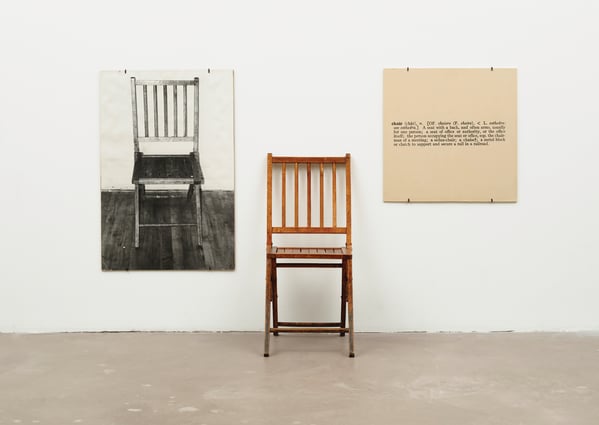
Analisi esperta di One and Three Chairs di Joseph Kosuth
Stile: Conceptual Art · Genere: installation
Expert Analysis: "One and Three Chairs" (1965) by Joseph Kosuth
As a landmark of Conceptual Art, Joseph Kosuth’s One and Three Chairs radically redefines the nature of an artwork by shifting focus from material craftsmanship to intellectual inquiry. The piece consists of three components: a physical wooden chair, a life-size photograph of that same chair, and a printed dictionary definition of the word “chair.” Installed together, they form a tautological system that forces the viewer to question what, exactly, constitutes the “real” chair.
Significance within Conceptual Art and its Period
-
Challenging Traditional Representation: Kosuth directly interrogates the relationship between object, image, and language. By presenting the actual chair, its photographic reproduction, and its verbal definition simultaneously, he dismantles the conventional hierarchy that privileges the original object. None of the three elements is more “true” or “authentic” than the others—they are merely different modes of presenting the same idea.
-
Art as Idea: One and Three Chairs exemplifies Conceptual Art’s central tenet: that the concept or idea behind the work is paramount, often outweighing its physical execution. Kosuth’s installation is not a static object to be admired aesthetically; it is a proposition about perception, meaning, and the systems of knowledge that define reality. The work itself is an analytical gesture, placing art in the realm of philosophy and linguistics.
-
Influence on Installation and Dematerialization: As an installation, the piece activates the gallery space as a site for intellectual engagement rather than sensory pleasure. It prefigured the “dematerialization of the art object” that became a hallmark of late-1960s conceptual practice, arguing that art could exist as a set of relationships or propositions rather than a unique, handmade artifact.
By reducing art to a self-referential puzzle about definition and representation, Kosuth’s One and Three Chairs remains a pivotal work that forced the art world to reconsider the very boundaries of what art can be—shifting the emphasis from what you see to how and why you see it.
Museum / Gallery
Visivamente simili
20 opere con composizione e palette affini
The blue chairs II
Panayiotis Tetsis
In Memory of Diebenkorn
Sloba Pajkovic
Trąbka do słuchania krzesła Pana Kantora
Lech Jankowski
The Painter
Irfan Ajvazi

Untitled
Hélène de Beauvoir
Waiting
Will Barnet
Interior with Doorway
Richard Diebenkorn

Kokstad7
MAUREEN QUIN
Chair by the Window
Sloba Pajkovic
People in the Sun
Edward Hopper
Paris Szent György Square
Bela Czobel
Rhythm 2
Marina Abramović
Pilgrim
Robert Rauschenberg
Sketch
Yiannis Tsaroychis
Sketch
Yiannis Tsaroychis
Emotion Sickness
Ahmed Mhennaoui
Two Kennedy Administration Cabinet Room Chairs
Danh Vō
Chair Designed for House Bloemenwerf
Henry van de Velde
Pilgrim
Robert Rauschenberg
Chair/Chair
Richard Artschwager