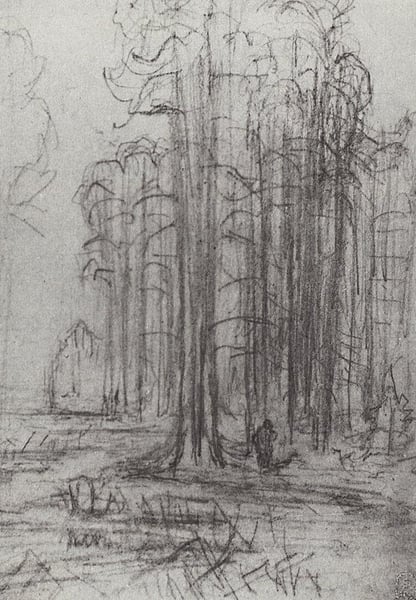
Forest landscape
Expert analysis of Arkhyp Kuindzhi’s Forest landscape
Style: Realism · Genre: sketch and study
Expert Art Historical Analysis: "Forest Landscape" by Arkhyp Kuindzhi
Arkhyp Kuindzhi (1842–1910) occupies a unique position in 19th-century Russian landscape painting, bridging the meticulous detail of Realism with the luminous, almost mystical atmosphere that would later influence early Symbolism and even proto-Impressionism. His Forest Landscape—identified here as a sketch and study—offers a rare window into the working methods of an artist renowned for his dramatic use of light and color.
Significance within Realism and Kuindzhi’s Oeuvre
While Kuindzhi’s most famous works (e.g., Moonlit Night on the Dnieper, Birch Grove) are finished canvases famed for their radiant, almost theatrical moonlight and sunlight, this sketch captures the raw observational essence of Realism. Realist landscape artists sought to depict nature truthfully, often en plein air, emphasizing atmospheric conditions and the transient effects of light. Here, the sketch format allows Kuindzhi to focus on three core elements:
-
Structure over Detail: Unlike a polished work, this study prioritizes the underlying geometry of the forest—the vertical thrust of tree trunks, the massing of foliage, and the recession of space into the deep, shadowy interior. This reveals Kuindzhi’s disciplined eye for composition, a foundation for his later, more dazzling light effects.
-
Tonality and Mood: The absence of strong chromatic brilliance (typical of a preliminary sketch) forces attention on value contrasts. Kuindzhi’s handling of dappled shade and the darker undergrowth anticipates his signature ability to create a sense of eerie stillness or spiritual solitude within nature. Even in a study, he infuses the forest with a hushed, contemplative mood.
-
Process as Artifact: As a sketch, the work is significant because it documents Kuindzhi’s immediate, unmediated response to the landscape. In art history, such studies are invaluable for understanding an artist’s transition from direct observation to the stylized, heightened reality of his completed masterpieces. It shows him as a disciplined Realist before he pushes into more subjective, luminous territories.
Conclusion: Forest Landscape may lack the dramatic spectacle of Kuindzhi’s iconic scenes, but its significance lies in its raw authenticity and technical preparation. It exemplifies the core Realist commitment to truth-to-nature while foreshadowing the atmospheric innovations that would make Kuindzhi a pivotal figure in Russian art—a painter who used the language of Realism to whisper of the sublime.
Visually similar
20 works with related composition and palette
Forest cutting
Ivan Shishkin
Pines
Ivan Shishkin
In the Woods
Paul Cezanne
The sketch for the painting "Rye"
Ivan Shishkin
Pine Trees in the Fen
Vincent van Gogh
Landscape
Aleksey Savrasov
Trunks of the trees
Isaac Levitan
Pines on the shores of Lake
Aleksey Savrasov
Deciduous Forest
Ivan Shishkin
Aspen on the way to Kivach
Ivan Shishkin
Forest near the water
Arkhyp Kuindzhi
Pine in marsh
Aleksey Savrasov
In the forest
Isaac Levitan
The Forest in Winter
Theodore Rousseau
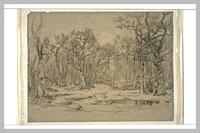
The Forest in Winter
Theodore Rousseau
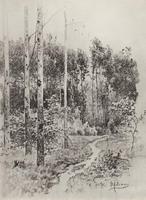
Path in the forest
Isaac Levitan
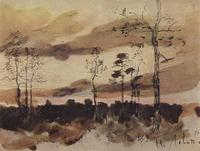
Sunset. Forest edge.
Isaac Levitan
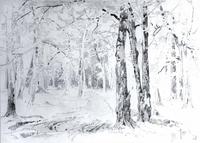
The road in forest
Ivan Shishkin
Landscape
John Henry Twachtman
In the deciduous forest
Ivan Shishkin