Expert analysis of Arkhyp Kuindzhi’s Moonlight in a Forest. Winter
Style: Impressionism · Genre: landscape
Expert Analysis: "Moonlight in a Forest. Winter" by Arkhyp Kuindzhi
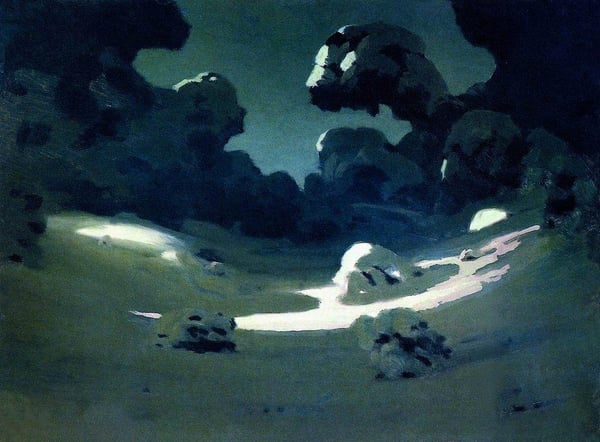
Arkhyp Kuindzhi’s “Moonlight in a Forest. Winter” stands as a remarkable fusion of Impressionist technique with a distinctly Russian sensitivity to atmospheric light and seasonal mood. Though Kuindzhi is often associated with the Peredvizhniki (the Wanderers), his later works—including this winter landscape—embrace the core Impressionist preoccupation with capturing transient light effects.
What makes this work significant:
-
Mastery of Luminosity – Kuindzhi was celebrated for his uncanny ability to render moonlight with an almost supernatural glow. In “Moonlight in a Forest. Winter,” the silver-blue light pierces through the bare branches, casting deep violet shadows on the snow. This interplay of cool, luminous whites and rich, dark blues creates a dreamlike stillness that goes beyond mere representation, evoking the hushed silence of a frozen night.
-
Innovative Use of Color – While traditional winter landscapes often rely on monochromatic palettes, Kuindzhi employs Impressionist broken color—touches of pale yellow, icy blue, and muted lavender—to suggest the reflection of moonlight on snow. This technique, similar to that of Monet or Sisley, imbues the scene with a shimmering, almost ethereal quality that feels both immediate and timeless.
-
Psychological Depth – The painting is not merely a record of a winter forest; it is a meditation on solitude and the sublime. Kuindzhi’s dramatic contrasts between the bright, moonlit clearing and the encroaching darkness of the trees create a powerful sense of mystery. The viewer is drawn into the scene, feeling the crisp cold and the eerie beauty of nature at night.
-
Bridging Movements – Kuindzhi’s work here exemplifies how Russian landscape painting absorbed and transformed European Impressionism. Rather than focusing on leisure or urban life (common in French Impressionism), he applies those same optical principles to the vast, quiet wilderness—anchoring the style in a deeply emotional, national landscape tradition.
In summary, “Moonlight in a Forest. Winter” is significant for its breathtaking handling of nocturnal light, its subtle yet powerful color harmony, and its ability to transcend simple description into an immersive, contemplative experience. It showcases Kuindzhi at the height of his powers, proving that Impressionism could be as poetic and profound in a Russian winter forest as in a Parisian garden.
Visually similar
20 works with related composition and palette
Winter. Sunlight on The Hoar Frost
Arkhyp Kuindzhi
Sunset Effect
Arkhyp Kuindzhi
Moonlight Night. Winter
Arkhyp Kuindzhi
In the Wild North
Ivan Shishkin
Prologue
Viktor Vasnetsov
Winter
Arkhyp Kuindzhi
Prologue. Forest.
Nicholas Roerich
Landscape with wolves
Aleksey Savrasov
Grove
Arkhyp Kuindzhi
In winter
Ivan Shishkin
Forest Glade. Fog
Arkhyp Kuindzhi
Deer in the Snow
Gustave Courbet
Winter Landscape Over the Sea of Fog
Karl Hauptmann
From the Mountains
Hans Gude
Winter Landscape
Fanny Churberg
Evening on the Prarie
Albert Bierstadt
Clouds
Arkhyp Kuindzhi
The Weary Waste of Snow, Forest of Birse, Aberdeenshire
Joseph Farquharson
The Weary Waste of Snow
Joseph Farquharson
Winter Landscape from Queen Christina’s Road in Djurgården, Stockholm
Charles XV of Sweden