Analisi esperta di Winter di Arkhyp Kuindzhi
Stile: Impressionism · Genere: landscape
Expert Art Historical Analysis: "Winter" by Arkhyp Kuindzhi
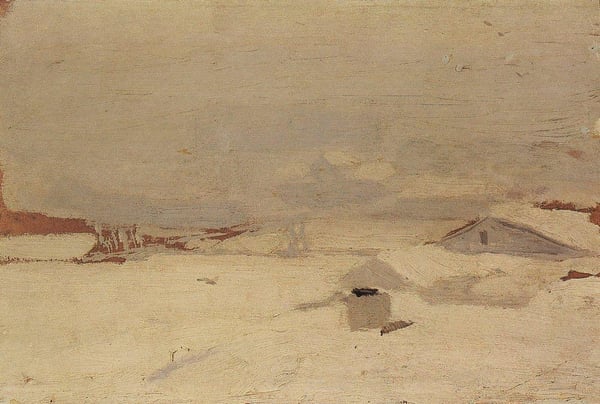
Arkhyp Kuindzhi’s "Winter" stands as a pivotal work within Russian Impressionism, marking a radical departure from the darker, more narrative-driven landscapes of the earlier 19th century. While the piece is firmly rooted in the landscape genre, its significance lies in Kuindzhi’s masterful manipulation of light, color, and atmosphere—hallmarks that set him apart from his contemporaries and anticipated the later experiments of the Russian avant-garde.
Composition and Atmospheric Effect
Kuindzhi presents a stark, snow-covered scene with an almost hypnotic simplicity. The composition is dominated by an expansive, unbroken white plane—the snow—which stretches toward a low horizon. By minimizing topographical details (e.g., trees, structures), the artist forces the viewer’s attention onto the modulated tones of white, blue, and gray. The sky is typically rendered in subtle gradations of pale lavender and icy blue, suggesting a low-hanging winter sun or the fleeting twilight of a northern winter day. This reduction of elements is key: Kuindzhi treats the landscape not as a factual record but as a vehicle for atmospheric sensation.
Luminosity and the "Kuindzhi Effect"
What makes "Winter" significant within Impressionism—and within Kuindzhi’s oeuvre—is his radical approach to light. Unlike French Impressionists who broke color into distinct dabs and strokes, Kuindzhi achieved luminosity through carefully layered glazes and stark tonal contrasts. The snow in "Winter" appears to emit its own cold, internal light, as if reflecting an unseen sun. This "luminism," often compared to the work of J.M.W. Turner, was dubbed the "Kuindzhi Effect" by Russian critics. In "Winter," that effect is especially poignant: the pure white snow is fractured by delicate blue shadows, creating a sense of depth and vibration without using heavy impasto. The result is a landscape that feels both tangible and dreamlike.
Departure from the Peredvizhniki Tradition
Kuindzhi was a member of the Peredvizhniki (The Wanderers), a group committed to social realism and national themes. Yet "Winter" shows his move away from their moralizing, anecdotal landscapes. There is no human figure, no narrative of peasant struggle or national identity—only the sublime, almost abstract experience of cold and silence. This embrace of pure sensory perception aligns with the core of Impressionism but does so through a distinctly Russian lens: the vast, untamed expanses of the Russian winter become a subject of contemplative beauty rather than social documentation.
Influence on Later Russian Art
The painting’s simplification of form and its haunting, otherworldly light directly influenced younger artists like Nicholas Roerich and the Symbolists, who saw in Kuindzhi’s "Winter" a path toward mystical, non-narrative landscapes. It also prefigures the color-field explorations of early 20th-century abstraction. By prioritizing the emotive power of light over topographic exactitude, Kuindzhi elevated the winter landscape from mere seasonal study to a meditation on nature’s elemental forces.
In summary, "Winter" is significant as a masterwork of Russian Impressionism that encapsulates Kuindzhi’s signature luminosity, his break from narrative naturalism, and his profound ability to transform a simple icy vista into a transcendent, almost spiritual experience.
Visivamente simili
20 opere con composizione e palette affini
Houses in the Snow, Norway
Claude Monet
Snow Scene
John Henry Twachtman
Winter Landscape
John Henry Twachtman
An Early Winter
John Henry Twachtman
Snow Scene
John Henry Twachtman
Winter Landscape
Pierre Daura
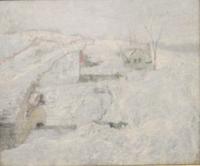
Greenwich Hills in Winter
John Henry Twachtman
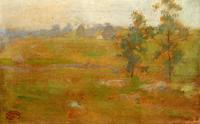
Summer Landscape
John Henry Twachtman
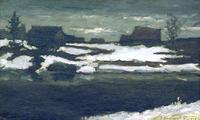
Ледоход
Vitold Byalynitsky-Birulya
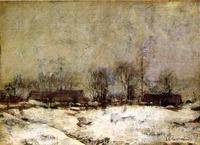
Winter Landscape, Cincinnati
John Henry Twachtman
A View of Templestowe
Arthur Streeton
Snow Scene at Utica
John Henry Twachtman
Houses in the Snow
Claude Monet
Dag I Mars
Pekka Halonen
Landscape in Moonlight
Henry Ossawa Tanner
Alaska Sunset
Sydney Laurence
Winter Sun
Eero Järnefelt
Last Snow
Konstantin Korovin
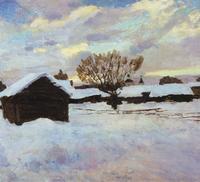
Clearing Skyes
Igor Grabar
Heat Haze
Dorrit Black