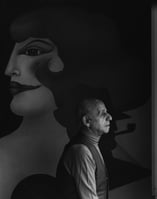
Expert analysis of Richard Lindner’s Anna
Style: Mechanistic Cubism · Genre: portrait
Expert Analysis: "Anna" by Richard Lindner (Mechanistic Cubism, Portrait)
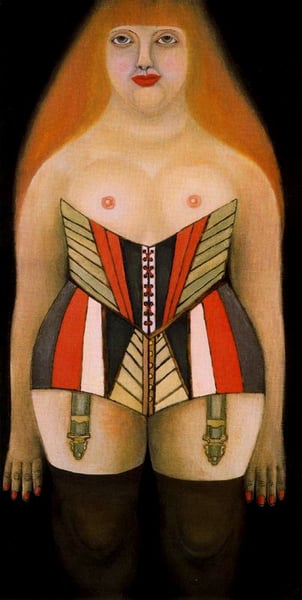
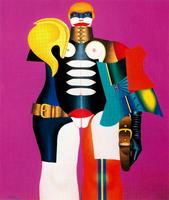
Richard Lindner’s "Anna" is a striking example of Mechanistic Cubism, a style that fuses the fragmented, multi-perspective geometries of Analytical and Synthetic Cubism with the cold, industrial aesthetic of machinery. As a portrait, the work transcends traditional representation, presenting the sitter not as a naturalistic likeness but as a constructed, engineered entity—a figure composed of interlocking, machine-like forms.
What makes it significant:
-
Bold synthesis of Cubist structure and mechanized form: Lindner distills the Cubist vocabulary—angular planes, shifted viewpoints, and flattened space—into a precisely ordered, almost architectural composition. The human face and body are reimagined as pistons, gears, or assembled metal parts, giving the portrait a sense of relentless, impersonal power. This mechanistic treatment was Lindner’s signature contribution, placing him at the intersection of Cubist abstraction and the emerging visual language of Pop Art.
-
Psychological impact through industrial dehumanization: The portrait genre is transformed from a vehicle for individuality into a commentary on modern alienation. "Anna" appears both authoritative and inanimate—a figure that embodies the tension between human identity and the dehumanizing forces of urban, technological society. Lindner’s use of hard edges, bold primary colors, and flat, sculptural shapes reinforces this sense of cold monumentality.
-
Bridging Cubism and Pop Art: While rooted in early 20th‑century Cubist principles, Lindner’s mechanistic approach prefigures the ironic, mass‑culture sensibilities of 1960s Pop Art. His portraits of women like "Anna" often feature exaggerated, doll‑like features and eroticized mechanical forms, anticipating the work of artists such as Roy Lichtenstein or James Rosenquist. The painting thus stands as a critical transitional work, updating Cubist abstraction for a postwar, machine‑age context.
In sum, "Anna" exemplifies how Mechanistic Cubism re‑energizes the portrait genre, using Cubist fragmentation as a tool to critique modernity while creating a visually compelling, unsettling icon.
Visually similar
20 works with related composition and palette
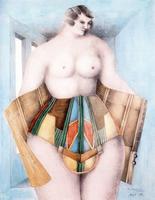
The Corset
Richard Lindner
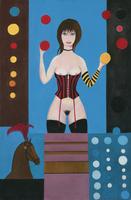
PRÓBA W LUNAPARKU
Kazimierz Mikulski

West 48th Street
Richard Lindner
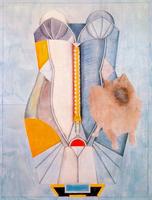
Suburban
Richard Lindner
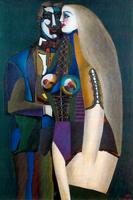
Pareja
Richard Lindner
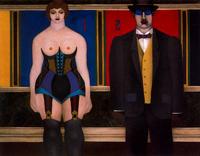
I-II
Richard Lindner
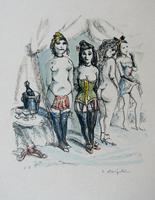
Readiness
Tsuguharu Foujita
Drawing of a corset
Louis Abel-Truchet
Three Graces
Carmen Delaco
Corset Le Furet
Leonetto Cappiello
Illustration to "A Week of Kindness"
Max Ernst
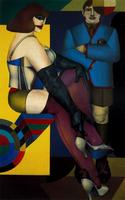
Untitled No. 2
Richard Lindner
Busto di Donna in Rosa
Domenico Gnoli
Woman Touching Her Arm
Edgar Degas

Imperial Countess Triangi-Taglioni
Christian Schad
Scheiber Hugó, Hölgy Egy Úrral Az Asztalnál, 1930
Scheiber Hugó

Untitled
John Kacere
Angel in Me
Richard Lindner

Woman with yellow shirt
Pablo Picasso
Femme sur Divan
Oscar Dominguez