
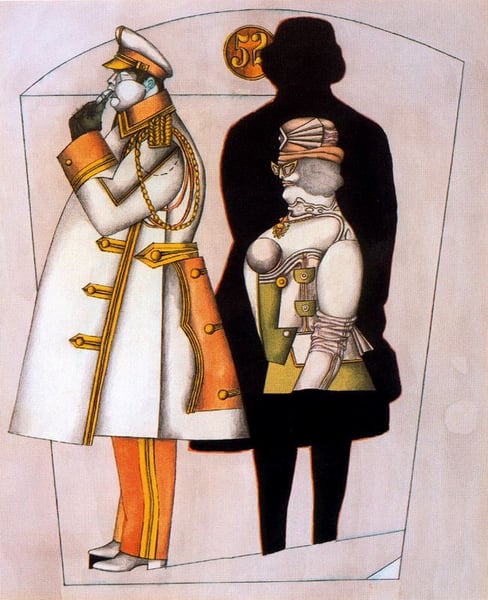
Fifth Avenue
Analisi esperta di Fifth Avenue di Richard Lindner
Stile: Mechanistic Cubism · Genere: genre painting
Expert Analysis: "Fifth Avenue" by Richard Lindner
Painted in the mid-20th century, Richard Lindner’s Fifth Avenue stands as a defining example of Mechanistic Cubism, a style that fuses the fractured, multi-perspective geometry of Analytical Cubism with the cold, precise aesthetic of machinery. As a genre painting, it captures a slice of urban life—specifically the bustling, anonymous energy of New York’s iconic thoroughfare—but transforms it through a lens that is both industrial and psychological.
What makes this work significant within its style and period:
-
Synthesis of Cubism and Mechanization: Lindner’s Mechanistic Cubism goes beyond formal experimentation. Here, human figures are rendered as assemblages of cylindrical, gear-like forms and sharp angular planes, echoing the rhythms of mass production and urban transit. The composition dissects the viewer’s gaze into overlapping, machined facets—a radical update of Cubism’s original concern with simultaneity, now applied to the dehumanizing pulse of the modern city.
-
Genre Painting Reinvented: Traditional genre scenes depict everyday life with warmth or narrative charm. In Fifth Avenue, Lindner subverts this by draining the scene of sentiment. Pedestrians become mannequin-like automatons; shop windows and street details are flattened into schematic, almost diagrammatic shapes. This turn reflects mid-century anxieties about identity, consumerism, and the loss of individuality in postwar America—making the work a critical, rather than nostalgic, genre painting.
-
Period Context: Executed during the rise of Pop Art and Neo-Dada, Fifth Avenue anticipates both movements. Its hard-edged, synthetic colors and graphic clarity prefigure Pop’s embrace of commercial imagery, while its mechanical dislocation of the human form resonates with the era’s fascination with technology and alienation. Lindner’s unique voice—neither fully abstract nor strictly representational—offers a bridge between European Cubist traditions and the emerging American fascination with the urban machine.
In essence, Fifth Avenue is significant because it weaponizes Cubist language for a critique of modern life, transforming a simple genre scene into a chilling, prescient vision of humanity as cogs within an aesthetic of steel and glass.
Visivamente simili
20 opere con composizione e palette affini
The Juggler
Richard Lindner
Officers of the Guard
Constantin Guys
Le Metro Necro
Theophile Steinlen
Peace
Raphael Kirchner
Pulling soldiers
Ferdinand Hodler
Ludwig II
Richard Lindner
Saluons Les
Theophile Steinlen
La Francontoise
Theophile Steinlen
Costume Design
Vadym Meller
Costume Design
Alexander Khvostenko-Khvostov
La Verite Et Les Deux Gendarmes
Theophile Steinlen
Costume design for an officer with a gun
Jury Annenkov
Untitled
Kukryniksy
Untitled (Portrait of Colonel Jack Francis Evans)
Henry Darger
A reception given by the possessed commander-in-chief (The TASS Window №899
Kukryniksy
Kopeikin and Napoléon
Marc Chagall
Ataman Platov
Boris Kustodiev
Wounded Soldier
Marc Chagall
The African King
Josef Capek
Saluons-Les
Theophile Steinlen